
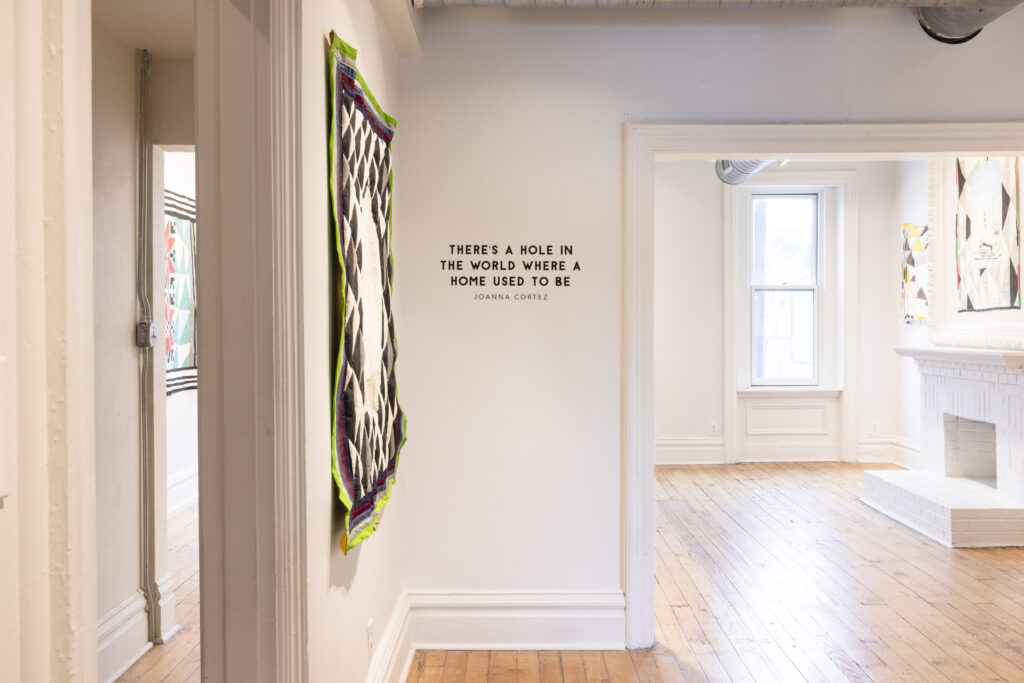
The night before I visited Bunker Projects on Dec. 7, I turned the name of its new exhibition, by Joanna Cortez, over in my mind. There’s a Hole in the World Where Home Used to Be. The phrase struck me deeply. I wondered if what I was feeling was because I’m part of two cultural diasporas or because I’m a textbook millennial perpetually plagued by nostalgia. It’s probably both.
Cortez says her show, currently on view through Jan. 18, “records direct efforts, like recent flotilla attempts, as well as indirect efforts, like the conservation of tatreez (Palestinian embroidery), historical efforts to allow Palestine the right to control its ports, and other actions meant to educate and encourage communities to work toward a free Palestine.”
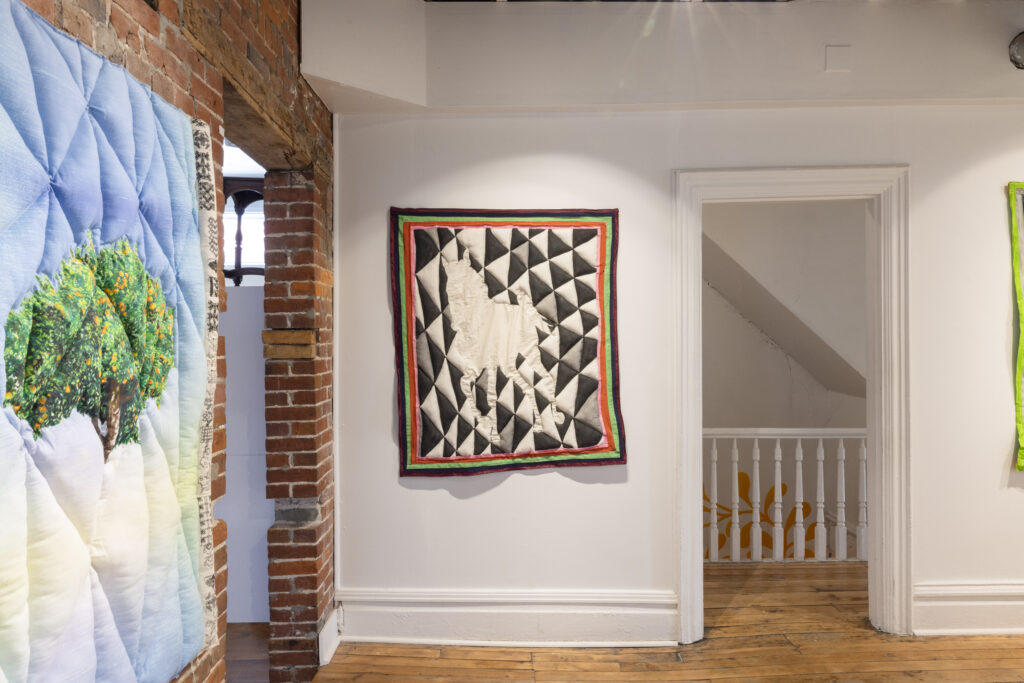
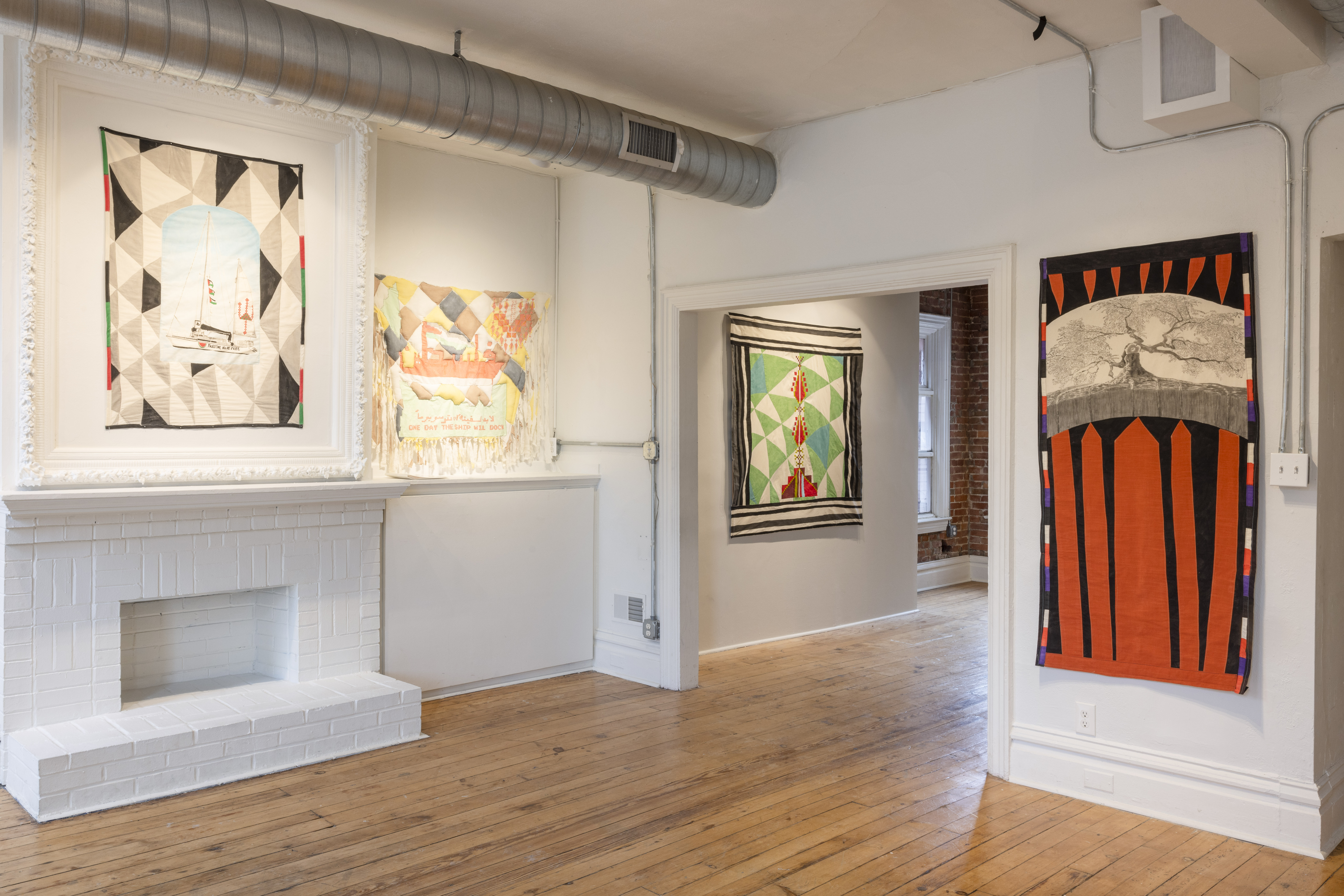
I entered the gallery knowing I was emotionally charged and unsure how that would influence my experience. I walked through Bunker’s two main gallery rooms slowly, visiting each of Cortez’s pieces in no particular order. I was met with vibrant hues and billowing quilted forms. It was a feast for the eyes to experience such color and texture, and I was surprised to discover most or all pieces were made from sturdy canvas materials and not the soft quilting cotton I had assumed from a distance. Then I discovered another illusion. These pieces give the effect of different fabrics sewn together, but, upon closer examination, Cortez had painted or printed the shapes onto a piece of canvas and stitched around the colors to mimic traditional quilting. They seemed to have been made quickly, almost in a frenzy.
Having some experience in textiles, these discoveries added another level of interest for me. What does a piece of cloth represent? Warmth, safety, comfort? A shroud holding the remains of a loved one gone too soon, or a piece of tent fabric serving as the only barrier between a body and the harsh sun or cold rain?
Time was an important factor in Cortez’s work. Materials and methods of execution feel secondary to what they symbolize, but are no less visually impactful for it. When viewing the fireplace wall near the back of the gallery space, I understood the role time plays in this work.
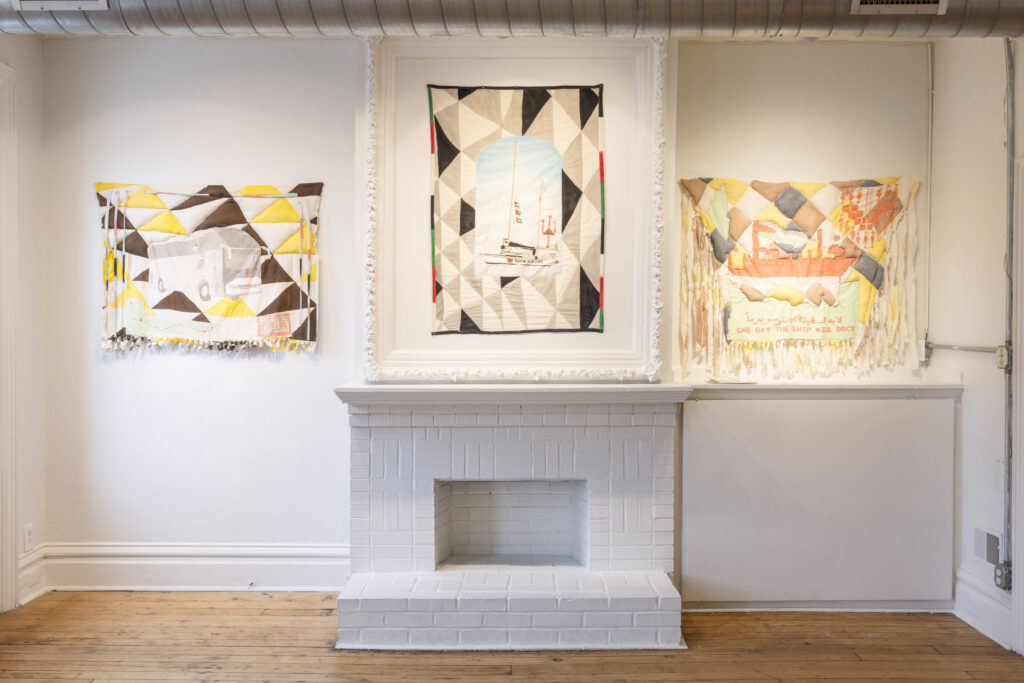
Three pieces—1,000 Madleens, Sumud Convoy, and One Day This Ship Will Dock—are documentation of recent efforts of global campaigns to challenge Israel’s blockade on Gaza and bring food, aid, and supplies to the Palestinian people. All pieces share a faded and tattered quality. I immediately got the sense that Cortez is representing current events through an ancestral lens.
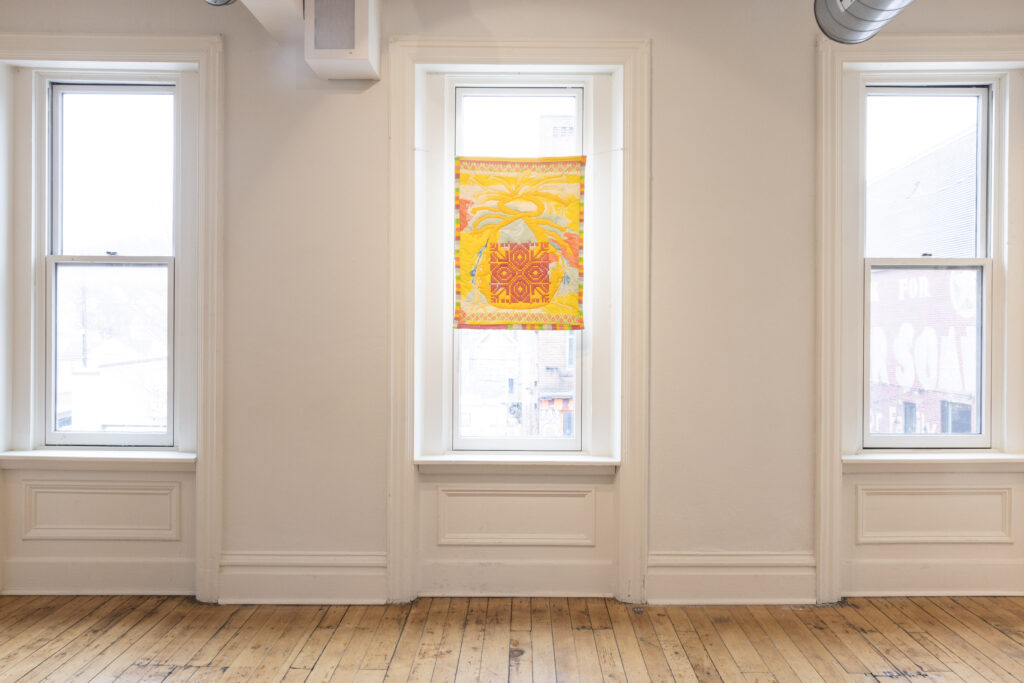
Nearby, Water Springs—situated among the larger-scale works—is a relatively small piece depicting a tree of life, surrounded by an array of Palestinian tatreez patterns. Floating above a red square pattern appliqued over the roots of the tree is what looks like a ghostly, photo-negative image of what I later learned was a Palestinian sunbird. Taken together, these elements form a layering of symbols that gesture through time, pointing to the depth and richness of Palestinian culture—one that devout Zionists often deny exists.
Almost directly across from Water Springs is Olive Harvest, another depiction of a tree that differs greatly in tone from much of the work in this exhibition. I immediately read it as an image made in mourning. The black-and-white rendering of an ancient olive tree shows it cut down, its upper branches fallen away to reveal a cross section of rings that speak to its age and the life it still had left to live.
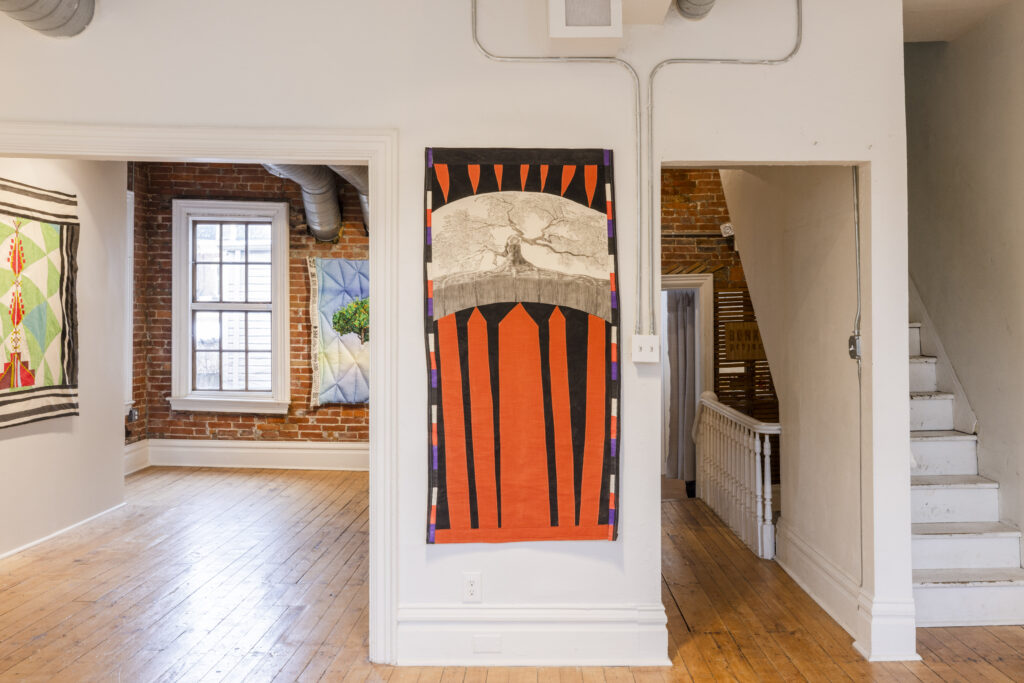
Encasing the scene are sharp black and orange-red shapes, resembling a mouth of teeth, connected to the roots and expanding downward through the work. The roots dig deep into the earth, nearly spilling over the edge of the image, like water—or blood. This imagery immediately recalled heartbreaking reports of IDF soldiers purposefully cutting down Palestinian olive trees to devastate farmers and their harvests. I found myself standing with the piece longer than expected, thinking about how the razing of trees is not only a material loss, but also a spiritual wound to a people so connected to their land, despite every effort to be removed from it. Though this image holds a lot of emotional weight, it doesn’t present like trauma porn—something to be consumed and then discarded. It’s wound can be mended by the keepers of the land.
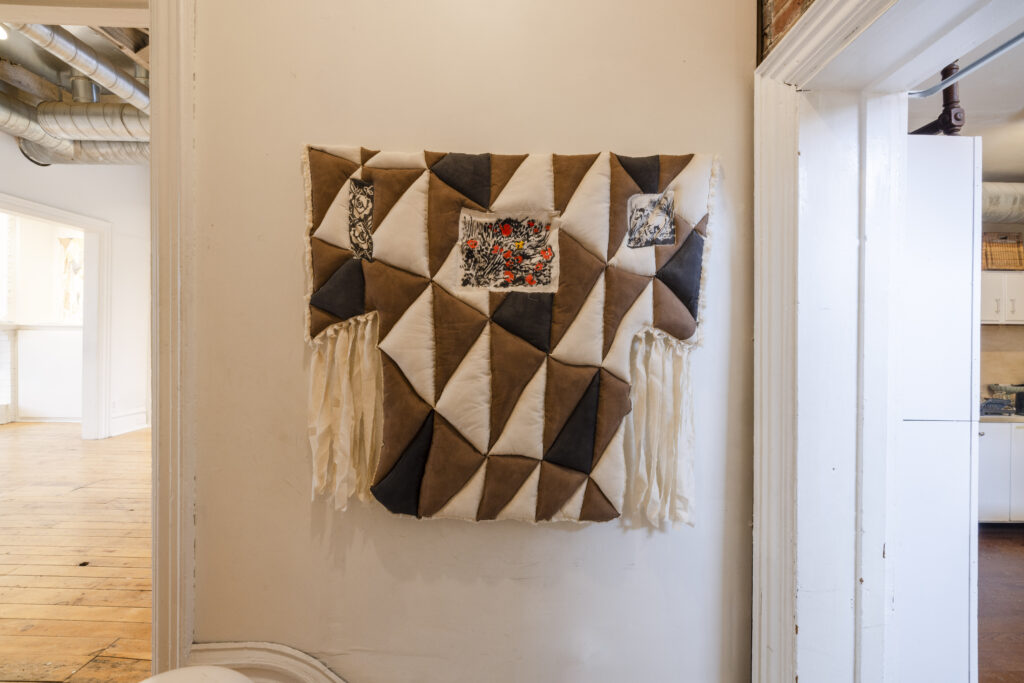
As I was leaving the gallery, Cortez pointed out a piece I missed at the top of the entrance stairs. Gold Sister, Red Sister is a plush, T-shaped form with a pillowy, quilted quality made of padded triangular sections in brown, cream and black. Hanging from the left and right are long strips of tattered fabric. Stitched to the top are three patches,the largest depicting a field of red poppies in tall grass with one gold poppy shining among them. To the left is an image of two roses painted in the style of a tatreez embroidery stitch pattern. To the right is the image of two horses running side by side.
Reflecting on this piece days later, I realized the dual images reminded me of my grandmothers, Lolita and Luz. Lolita was forced to leave Honduras following a military coup in the 1960s with my infant mother in tow. Luz, like many Puerto Ricans, left behind her land, burdened by pollution and poverty, conditions perpetuated by the very country she fled to. Both women expressed a love and yearning for their respective countries that I also wanted to feel and understand, but could only piece together through photos, stories, and keepsakes they preserved in their homes. Gold Sister, Red Sister evoked a feeling of kinship I have for all colonized peoples. I was responding to the way cultural history survives through time— and how so many are still fighting to preserve what’s left of their ancestral homes, in hopes to one day rebuild what was lost.
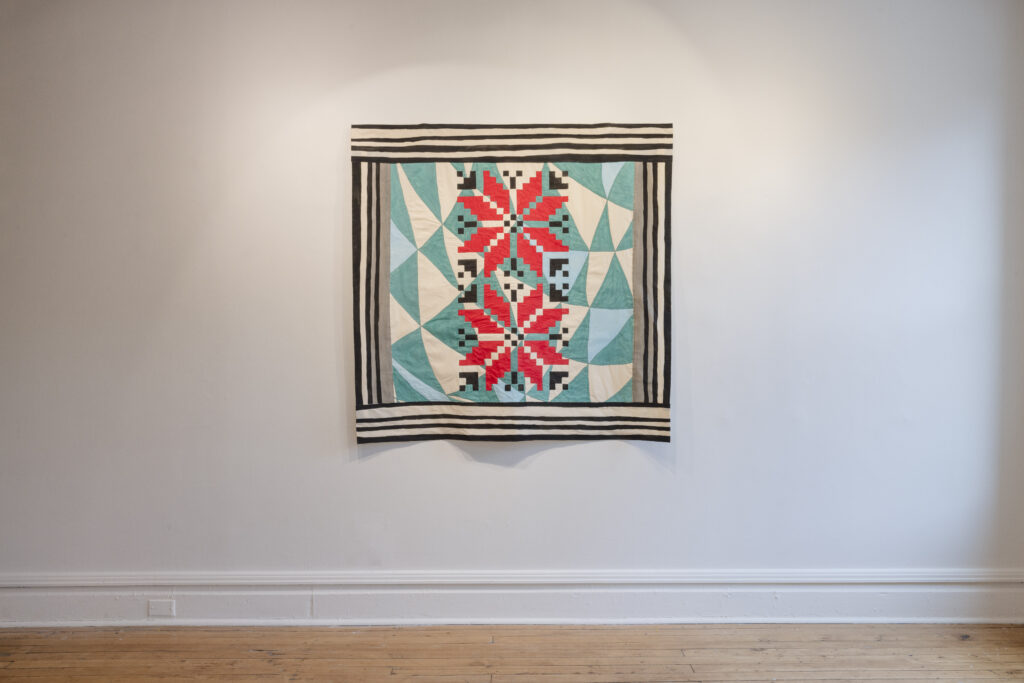
I finally understood why the title of this exhibition resonated with me so deeply. Many of Cortez’s pieces conjured the feeling of stumbling upon someone’s private journal—seeing fragments of memory, moments in time that have been lost and are begging to be found again. Beyond my personal cultural insights, I left the exhibition feeling challenged to learn more, to do more, to connect more, and affirming the truth that this fight for Palestinian freedom is bound to our collective freedom.
Photography by Anna Brewer
Ashley Ramos is a Pittsburgh-based visual artist and poet whose self-portraits explore themes of body liberation, self-reflection, and shadow work. Working primarily in oils, her art challenges societal norms and invites deep introspection. Through both her creative practice and activism, Ashley is committed to amplifying underrepresented voices, encouraging cultural exchange, and fostering inclusive spaces.
If you’d like to support Bunker Projects’ mission to provide a safe, equitable space for emerging artists to develop their practice and create new works for exhibition, please consider making a one-time or recurring donation here. We are so grateful for your generosity.