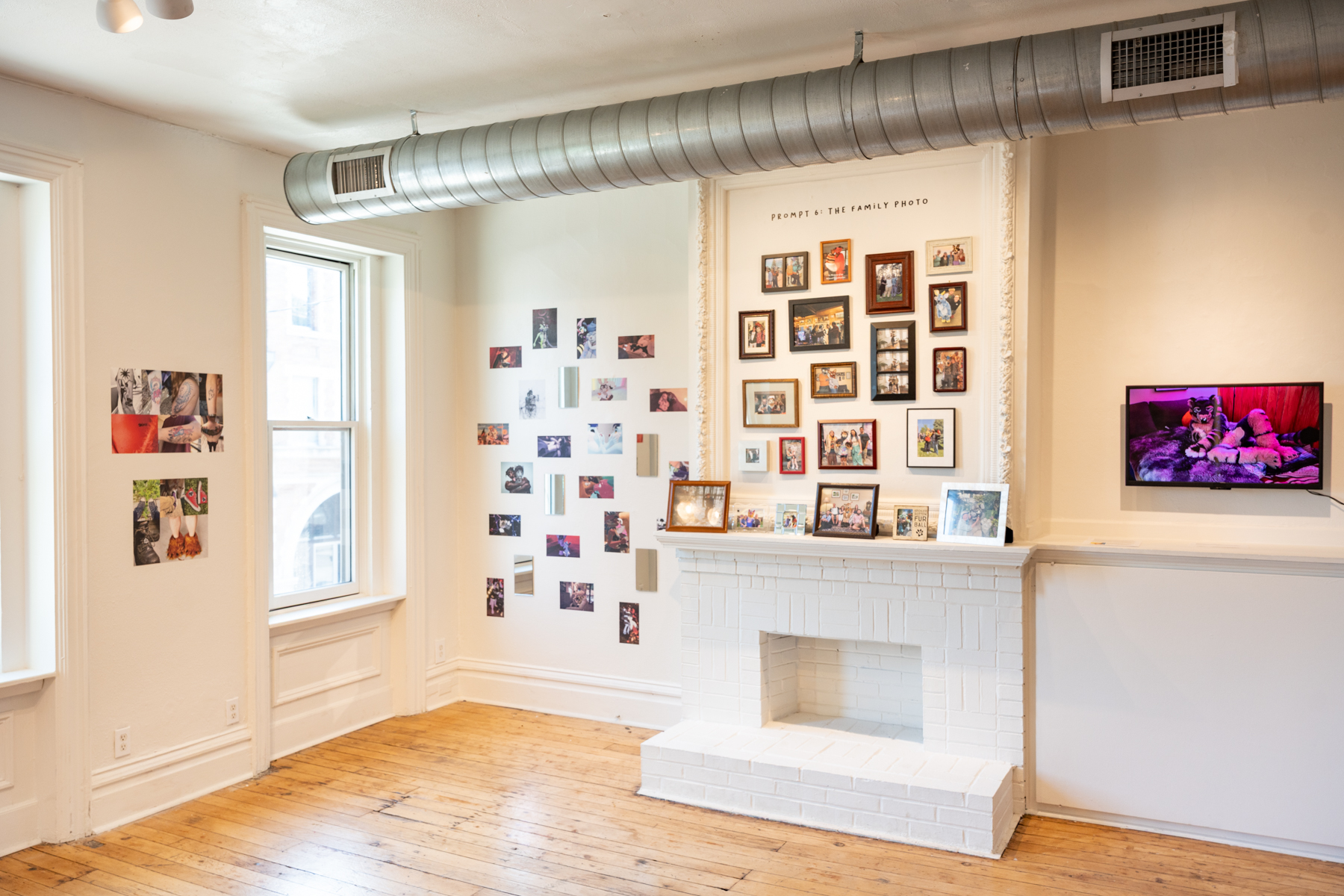

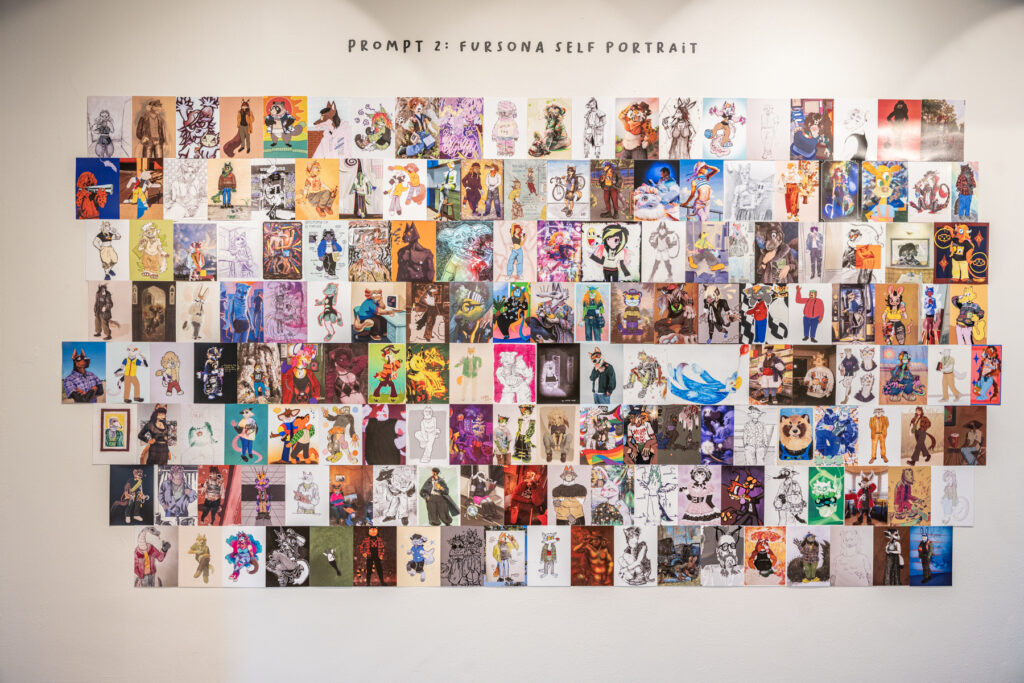
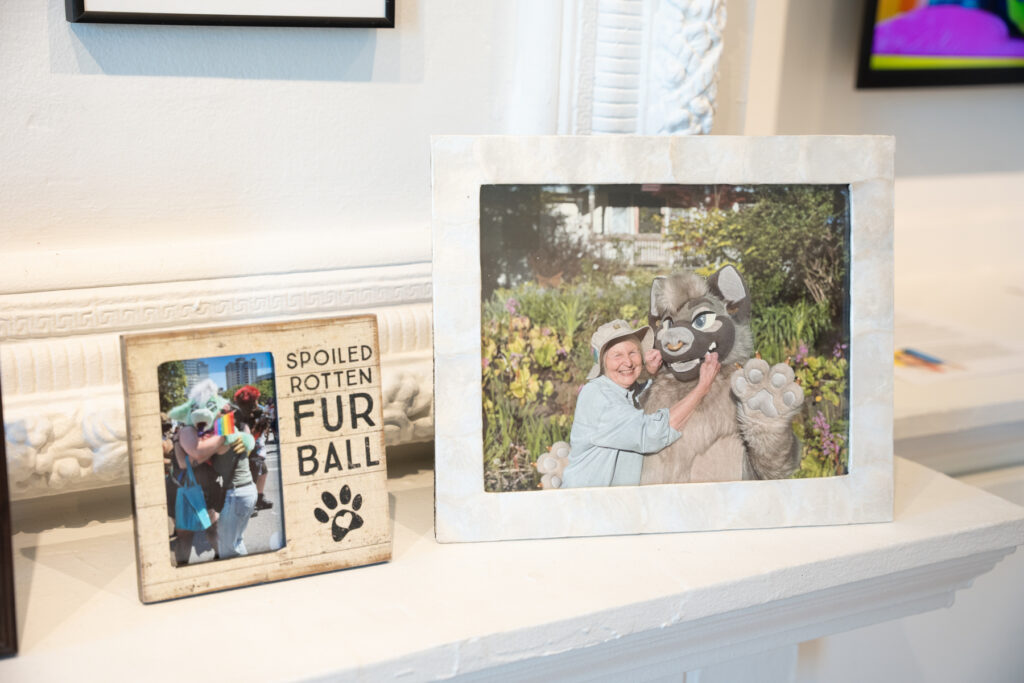
At the opening of I LOVE FURRY, I stand as part of an undulating crowd of friends and strangers, pointing at photos of ourselves, remembering who was there, what we were doing, and what it meant to be there. The images range from a landscape of candy-colored fursuiters milling around a hill, in front of a drab corporate hotel, to the barely-lit close-up of a hand touching the face of a fursuiter, gazing into the camera lens. As I stand with my friend Tommy Bruce, I point to the photo documenting a discussion of Brett Hanover’s Rukus, one in a sea of snapshots floating in front of us. “When I look at this,” I tell him, “I see the first day of my life.”
To an outside viewer, the party snapshots and group fursuit photos couldn’t be more innocuous. But that subversion repeats itself throughout Bruce’s show, I LOVE FURRY, as many tiny dramas play out in discreet harmony, endless within the boundaries of a photograph. You don’t see the forest until you stand still and let it live around you; in this gallery, you can watch the arcs of entire lives play out in sequence.
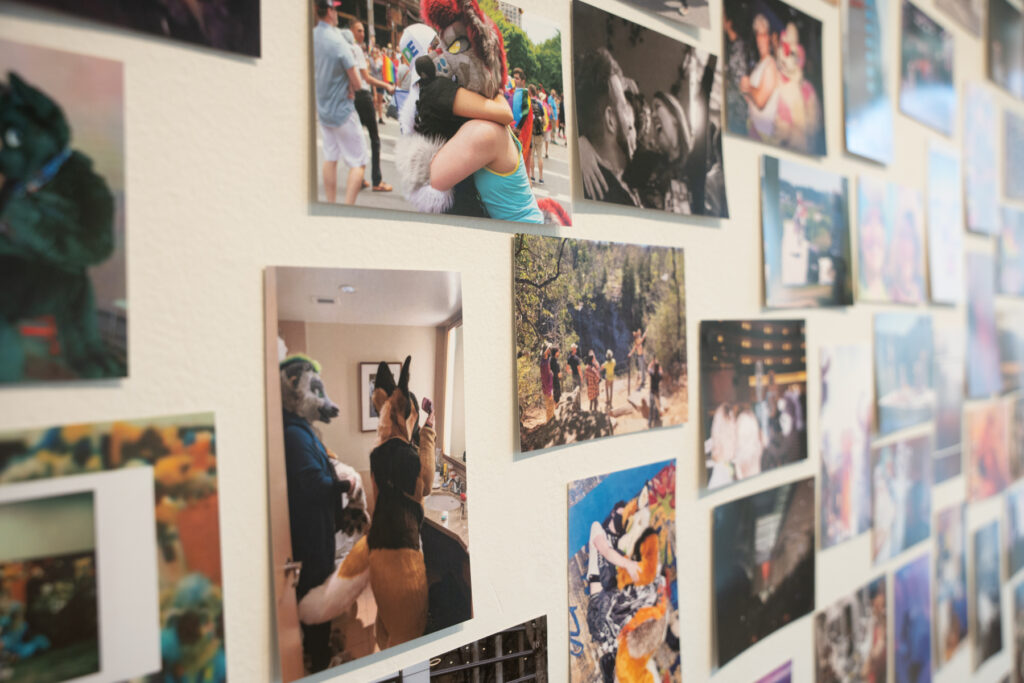
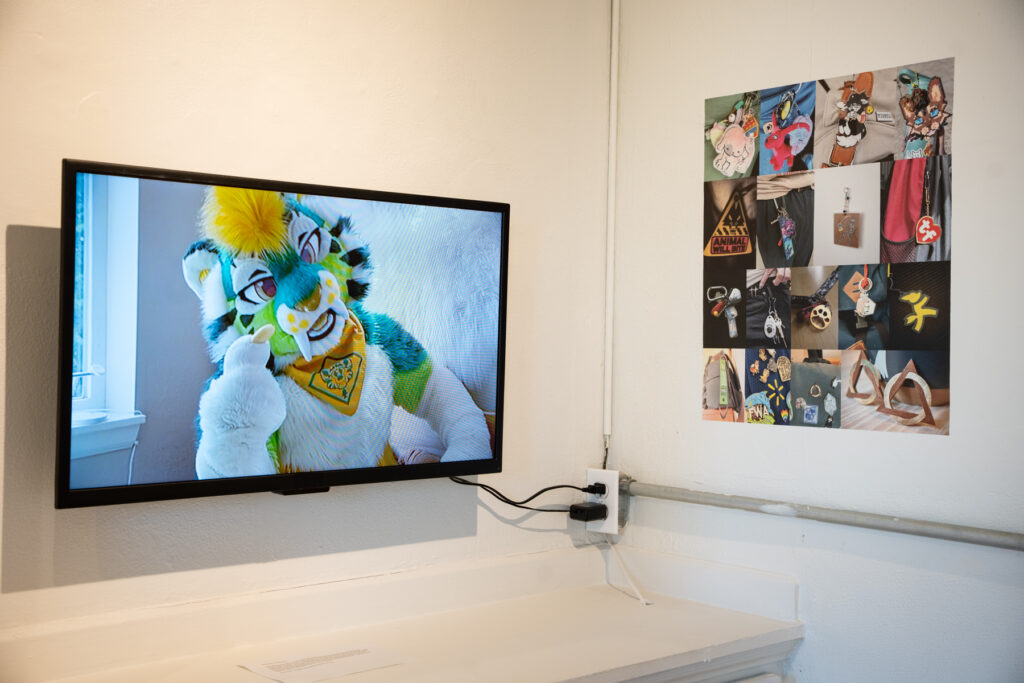
Inspired by Miranda July’s Learning to Love You More, Tommy has put immense care into giving the general furry public a means to show many of our most personal moments held in common. The imagery spans every order of imagined selves, inhabiting visual art, our stunning acrylic-and-fleece bodies, and even the humble paw print keychain. There is a concern for the furry experience at every level. We are nerds after all, and usually nerds about our own community: there’s an old adage that furries are simply ‘fans of each other’. Our primary shared interest is knowing other furries, whether from shared hobbies, creating/commissioning artwork, or finding each other at cons. While the images are beautiful on their own, they come to life when there’s a room full of furries pointing out and telling the story that each picture captures.
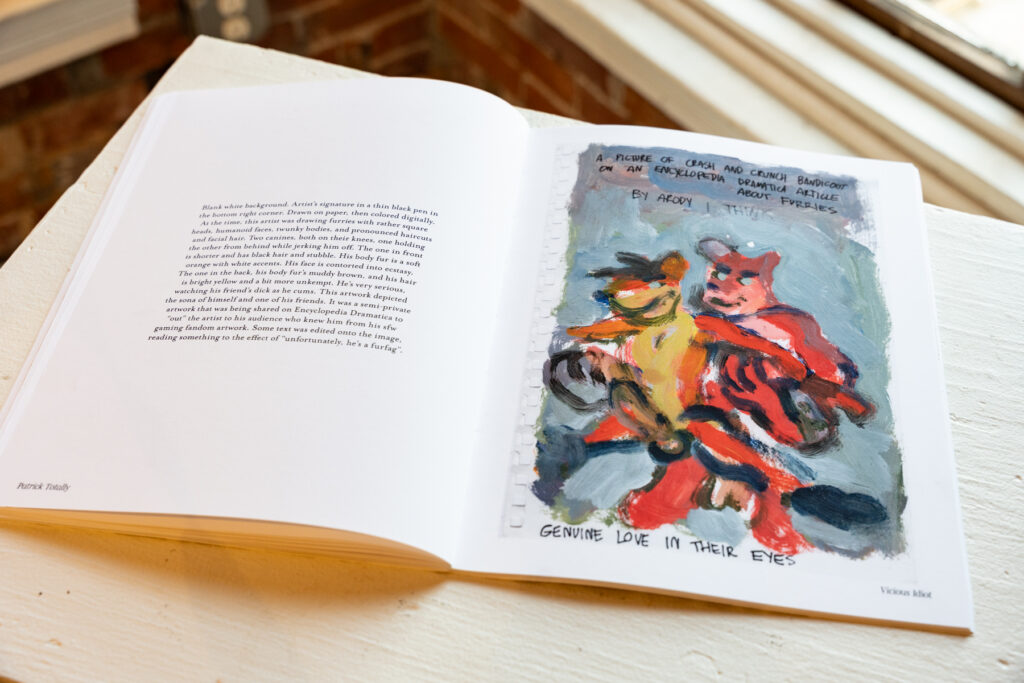
The gallery hums with the type of energy you can only find in a space with such dense detail on display. I find the loudest piece is the book seated in a bright corner, titled First Encounters. Several dozen people have detailed the moment they realized that there was something else out there. Furry awakening is often linked to adolescent queerness and alienation, and within these passages the amalgam of fear, shame, and euphoria feel just as potent as they did in my preteen years. The difference is that now, each of these moments is sharing space with a neighbor who feels the same way. The first time I went to a furry convention, it was Midwest Furfest in Rosemont, IL. It just so happened that I lived a 40-minute train ride away at the time, but I didn’t consciously think to go until the convention was already happening. Just after daybreak on the first Saturday in December, I wake up in a fit of depressive hedonism, thinking, “If I see one person I know here, it’ll be worth the cost of the day pass.” Over the next 20 hours, several dozen profile pictures become real faces who I can touch and hug in a way I never knew was allowed. When I return home, I am different, but no one knows yet. The closet has vanished, and all I have now is a world to share.
I stand in a corner of the gallery, watching friends and strangers point out pictures of themselves, friends and lovers, and those who aren’t with us any more. I can remember myself choking on dense air, bush whacking through overgrown trails on the Allegheny River, going to a nondescript parking garage to see our friends’ pop-up art show during Anthrocon, paintings and T-shirts sold out of the backs of cars, manic fervor to the whole operation, moving like it could be snuffed out by a single security guard at any moment. When I recall how we loitered in that empty lot for hours, I cry. Our friend Cypress, who set up the event and got all of us to venture away from the convention center with his ambition and charisma, would pass within the year. This is the first time the idea of a family reunion has made sense, and we could talk to each other for hours.
All of this fervor around fuzzy, queer weekend gatherings can be difficult to parse to outsiders. Even though we’re called a fandom, our common interest isn’t a specific media property, or even an attachment to real-life animals. There’s a draw to this culture that brings thousands of people, who feel set apart from those around them, into contact with one another. There were plenty of anthropomorphic enthusiasts throughout 20th-century nerd history, but they didn’t come together until the first furry room parties started happening in the late ’80s. What changed? Maybe a dark hotel room, a critical mass of people who could provide the miracle of safety, and the ease of leaning into another and, for the first time, encountering no resistance. I remember being invited to a room party to watch what Paul Peng called “some furry documentary,” adding, “but the director will be there, so it’s probably good.” That film was Brett’s Rukus, and it was my moment of no-turning-back from the fandom. When I cried in the TV’s glow, it was with my newfound furry siblings. When we discussed the film with Brett after, sweating it out on a blanched hotel duvet with warm beers in shaky hands, I noticed how they were just as affected as we were. We are created just as much by our relations to one another as we are by our mutual, innate longing for more-than-human experience.
When I get back to my apartment after the show, I look at the handmade, scrapbooky pin boards up in the living and bedrooms. Each of them is overloaded with furry ephemera: holiday cards, snapshots from new year’s day, and endless stickers. For the first time, I think about how many photos of me are up there, and how I never wanted to put a photo of myself on the wall until I shared the frame with these people.
Photography by Tommy Bruce
Lane Lincecum is a cartoonist, book artist and costume designer currently living in Pittsburgh. He was one of the co-curators of Bunker Projects’ summer 2025 exhibit, Room Party, and previously operated Toxic Metal Press out of Chicago, IL.