
Memory is weird. The ghost of a thing, the psychic residue of life. Something that feels true, but is more often distorted and incorrect. Something that fills in the gaps, something that changes the details—selectively fading and spotlighting different events, people and competing versions of both. There is a dim light of a memory of sitting across from Loc Huynh, eating tater tots and talking art at a hipster bar in Austin, Texas, 10 years ago. There is a better memory of taking him to Tram’s when he arrived in Pittsburgh for his residency at Bunker Projects nearly 10 years later, chatting up the one-armed waiter about having a portrait done. A year after that, this is the latest Loc Huynh memory on file, standing in the front row of the subconscious: his show at Bunker Projects, Fiberglass Dreams, Steel Nightmares, which as it turns out, is a show about memory.
The art of Huynh’s that always resonated with me were his vibrant, illustrative depictions of Houston/Texan/Vietnamese immigrant life and persons. Family scenes, portraits– intimate in detail, colorful and vivid, with a light technical touch and retro feel from his proficiency with the airbrush as a medium.
The show is about amusement parks—or the distortion of memory by the nostalgia produced by amusement parks as an enterprise of late-stage capitalism. Huynh’s work examines the park environment’s ability to make the natural world feel unnatural via grotesque reproduction or in the literal imprisonment of real animals as for profit entertainment. The understanding of the amusement park in a critical materialist framework, juxtaposed against Huynh’s own nostalgic memory or lack thereof, attempts to highlight the unreality of these places and inhabitant creatures.
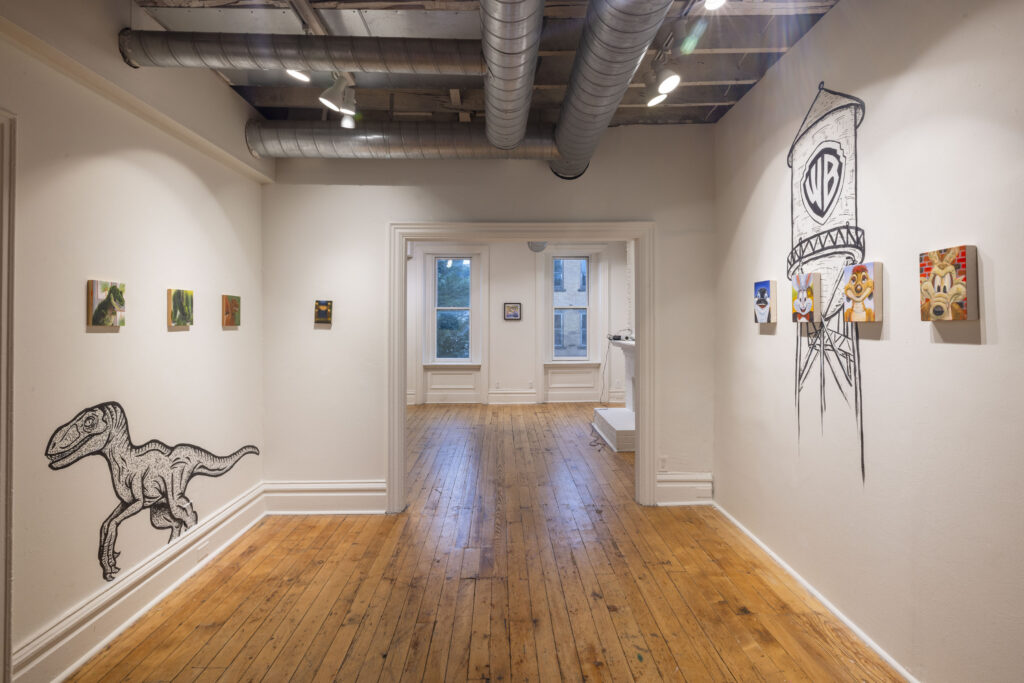
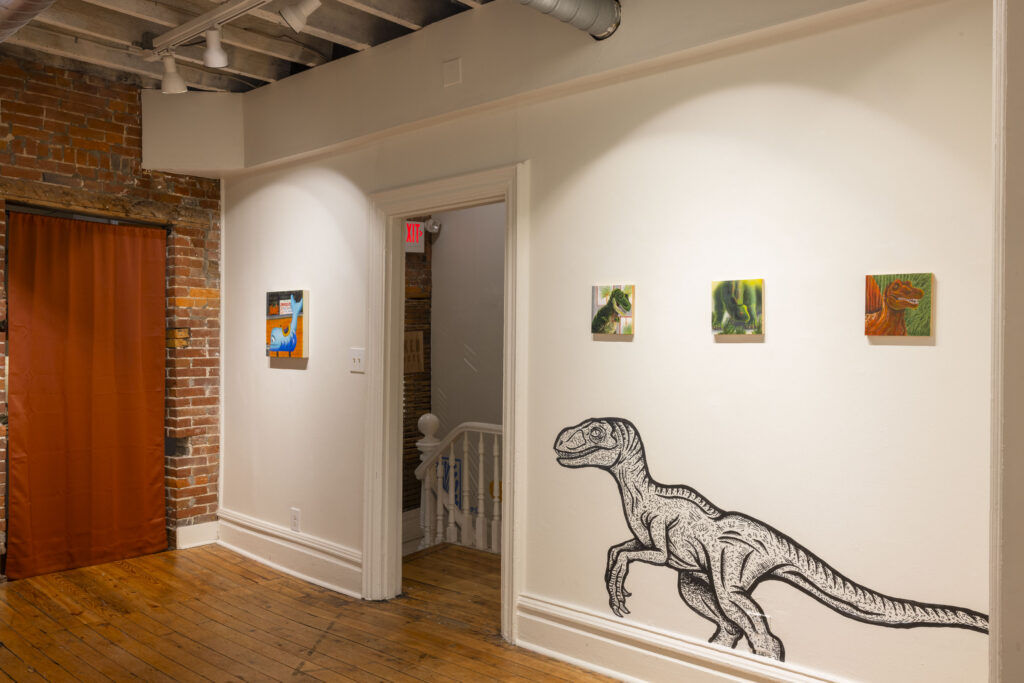
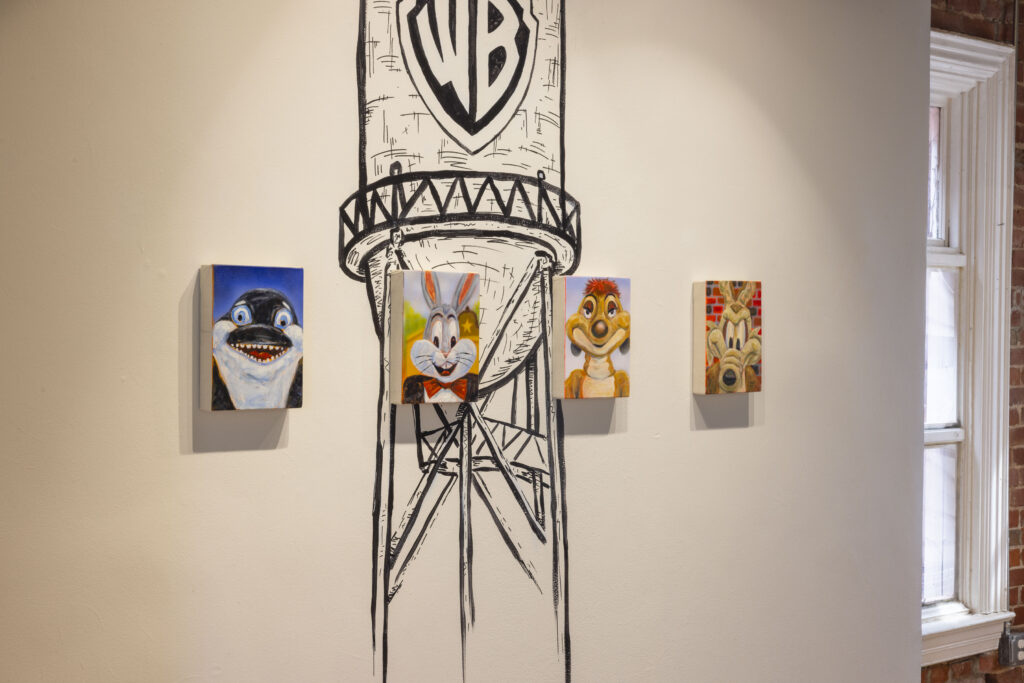
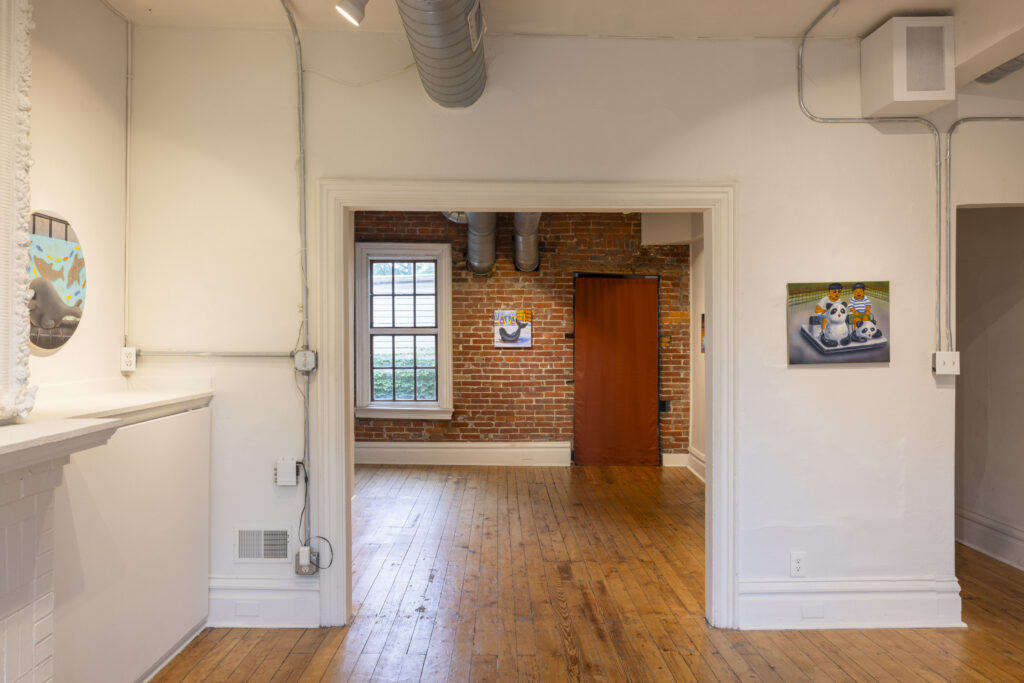
Most of Huynh’s pieces zero in on animal subjects—both park staff in anthropomorphic costume and the lumbering set pieces of giant dinosaurs and killer whales, as well as the cartoonish quarter vend vibrating horsey rides for small children. Notably, a few pictures depicted children in era-appropriate attire, standing awkwardly in front of mascots or cruising in a grotesque panda Go Kart. On the walls are wispy illustrations of the Warner Bros. water tower and a velociraptor, light linework in soft contrast with the walls, like ambient theme park landscaping. The photos were close-ups of dinosaurs and mascots, some scattered Warner Bros. B-listers cast in shadow and unnatural earth tones, producing a mild sense of dread.
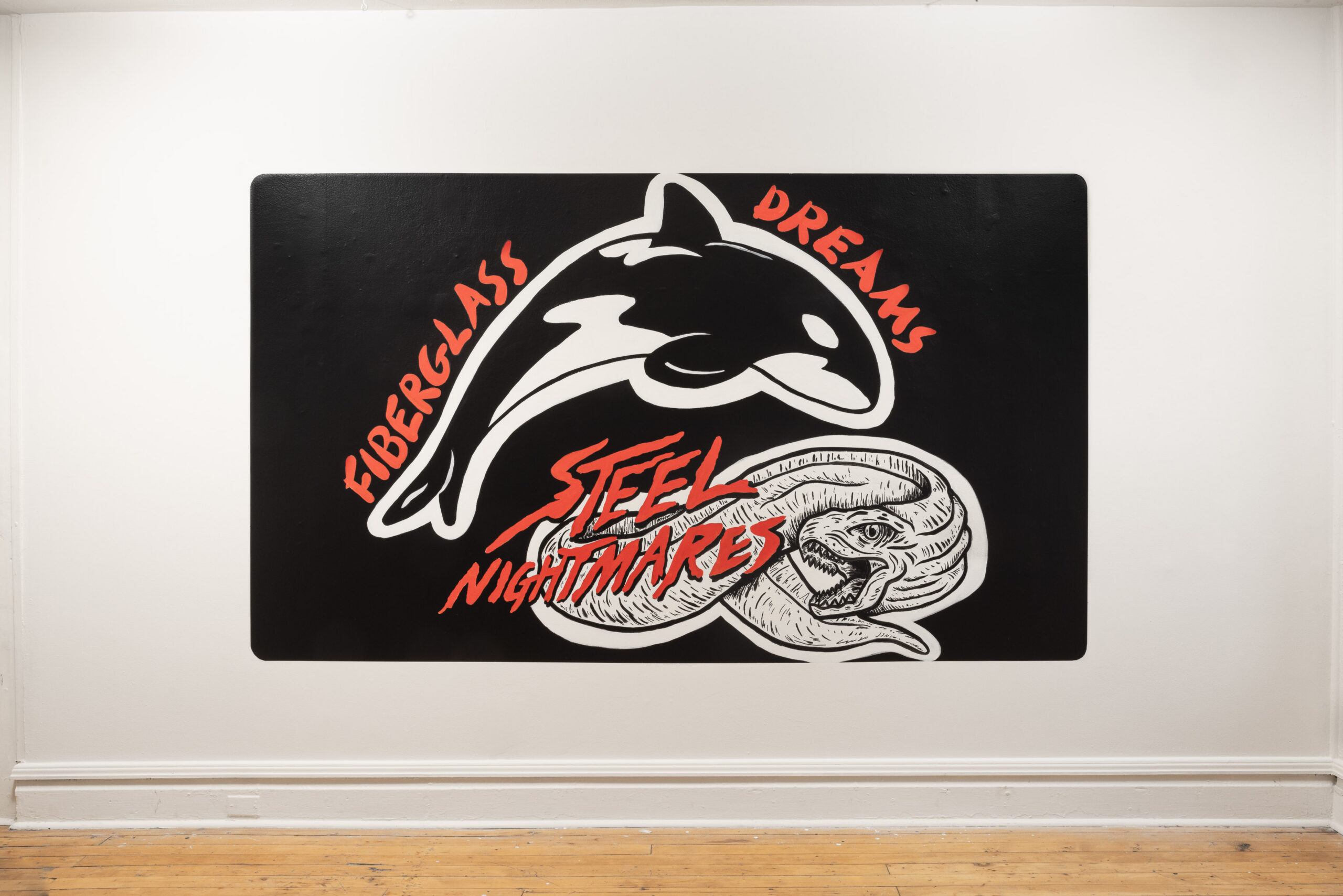
Turning the corner from the stairs, I was struck immediately by a wall of black, white and red—the show’s title card, a mural depicting an orca and a prehistoric eel, the words “nightmares” and “dreams” in bright red, stylized jagged type– all very ’90s. The color palette and iconography are ripped from the BlackBloc and eco-warrior days of the World Trade Organization protests, which would have been background noise during Huynh’s childhood, but not something I necessarily associate with my memory of his work.
In terms of the subject of the amusement park in its totality, Huynh seems to have left a lot on the table. Nowhere were the steel frames of the thrill rides, the looming and twisting architecture along neon paths like an alien city. The fried, barely natural food served at most amusement parks is also left untouched. But maybe most curiously absent (relative to what I know of Huynh’s larger body of work) was the human element, save the two portraits of Huynh as a child. The theme park staff and the exploitation of their labor, the mobs of parkgoers, the consumer milked for higher profits from upcharge after upcharge via the de-democratization of shit like waiting in line through tiered customer packages. The life in the myriad of human emotions intersecting on any given day such places and the continuum of narratives therein was noticeably missing. The focus felt singular and spotlight-y, a counterintuitive (if not incorrect) approach to representing the multi-faceted consumer spectacle that is the American amusement park.
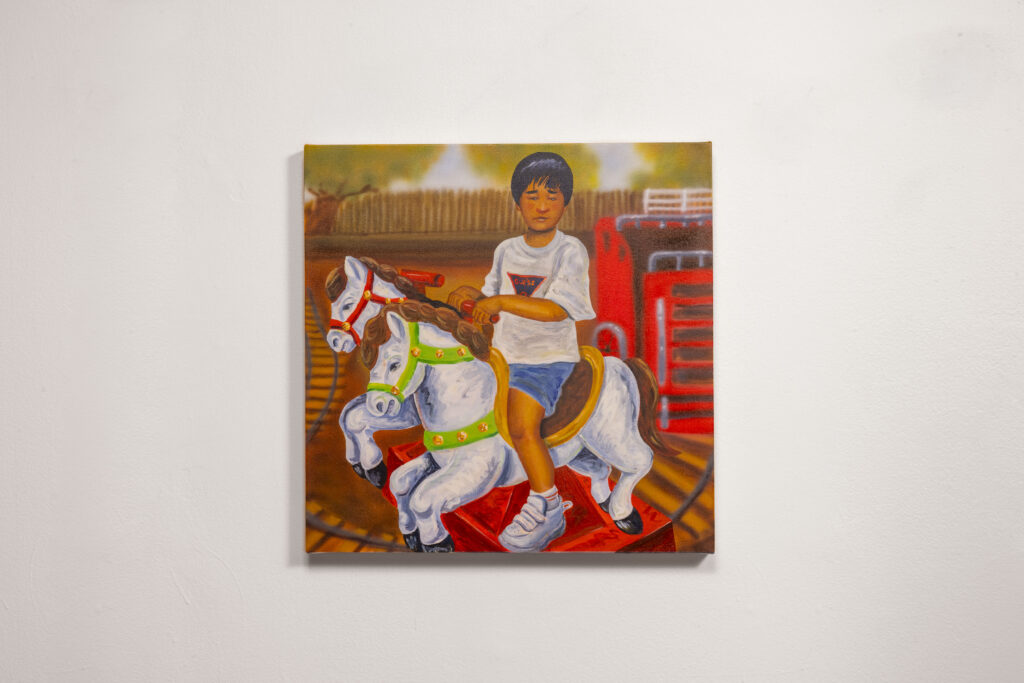
Not content to rest on my own initial interpretation, I called Huynh up to ask a few clarifying questions. As it turns out, what I felt was a limited scope was for a material reason: the paintings were based off physical images from family photos—a detail I failed to remember after my first read of the show statement. The images are real artifacts and a real-time documentation of memories by his family; the subjects of the photos are of their choosing. Huynh could not himself recall the events represented in the picture, and was reconstructing his own history. In this context, Fiberglass Dreams and Steel Nightmares is a hyper-specific episode in the larger body of Huynh’s work; a bottle episode in a larger multi-season storyline. These photos of childhood allow for windows into a relative history of family life and assimilation into the consumer culture of the unipolar moment in the U.S. in the 1990s. “All my paintings are historical paintings,” Huynh told me.
Still, even with the context clicking things together, it felt as if the subject was denied some grandeur by the intense intimacy of the source material. Huynh somewhat agreed, telling me that in a perfect world, with more time and productivity removed from the equation, he would have liked to do more with the installation to recreate the feeling of alien topography he does recall from his visits to the amusement park, walking underneath the color columns and twisted steel tracks of rollercoasters. And while I agreed that this would have been a nice touch, I wanted a deeper structural dissection of these “contaminated environments” that are perhaps beyond Huynh’s interest—or the limitations of relying on the past through someone else’s eye. But I can also accept that my critical “wish casting” is the inherent bias from being a follower of the immortal science. I bring a “ruthless criticism of all that exists” kinda vibe to the “exploration of the subjectivity of lived-experience” party that most people don’t like.
The correlation Huynh was touching on that was worth exploring was the dialectic between the alienation of fun/nature/sociality by the for-profit theme park itself and the alienation Huynh experienced from his own memory. Within both processes, there is an insidious kind of symmetry. If nostalgia is the commodified form of memory under capitalism, then Huynh’s act of forgetting is a boycott of the product. The ability to retroactively look at something that gave you so much feeling and feel nothing is liberation from its hold. The artificiality makes it all the easier. The subsequent reconstruction of this biographical footnote through the art is the subjective reflection on an objective and structural process–the way that a personal diary provides supplemental color to the total history, the color and life in the secondary and tertiary details of the past. In this way, Fiberglass Dreams, Steel Nightmares fits perfectly within Huynh’s larger body of work, while also standing out as an anomaly. Much like a TV bottle episode—or a day at the amusement park.
Photography by Anna Brewer
Brian Gonnella is an artist/writer/organizer living in Pittsburgh, PA. Inspired by conceptual artists like Mark Lombardi and the Sots Art movement, his paintings attempt to create hyper-visualizations of American consumerism by utilizing an interconnected iconography of reappropriated pop culture imagery, aiming to split the difference between cool commercial aesthetics and didactic function. His mural work is primarily focused on the response to the critiques raised in his paintings; celebrating the solidarity and community that exists between people outside of the material community of capital, either through both mystification of common liminal space or celebrating the ascendant power of working class, everyday people both historically and today. In 2017, he founded Spirit Walls at Spirit Hall in Pittsburgh’s Lawrenceville neighborhood, and he is one of the co-organizers of Pittsburgh Artist’s Autonomy Collective (PAAC), an artist collective dedicated to creating safe spaces for graffiti and street art in the city of Pittsburgh by partnering directly with community members.