

This year, I am working on becoming angry. In truth, I have been angry my whole life, accustomed to toning down this anger and burying it inside me so as to not come across as difficult or mean. What would it look like to exhibit my anger to the world?
There is a specific type of anger that develops early on when you experience injustice as a child. Something a bit like an overfilled pot reaching a roiling boil over and over while you adjust the heat. The multitude of feelings can’t actually be untangled when, as a child, you witness your parents being talked down to at the grocery store check out. The anger conflates with embarrassment, mixes with sadness and frustration as you get older. There is a specific type of anger that develops when you become the parent too early on, spurred on not only by personal suffering but by the systemic kind, too.
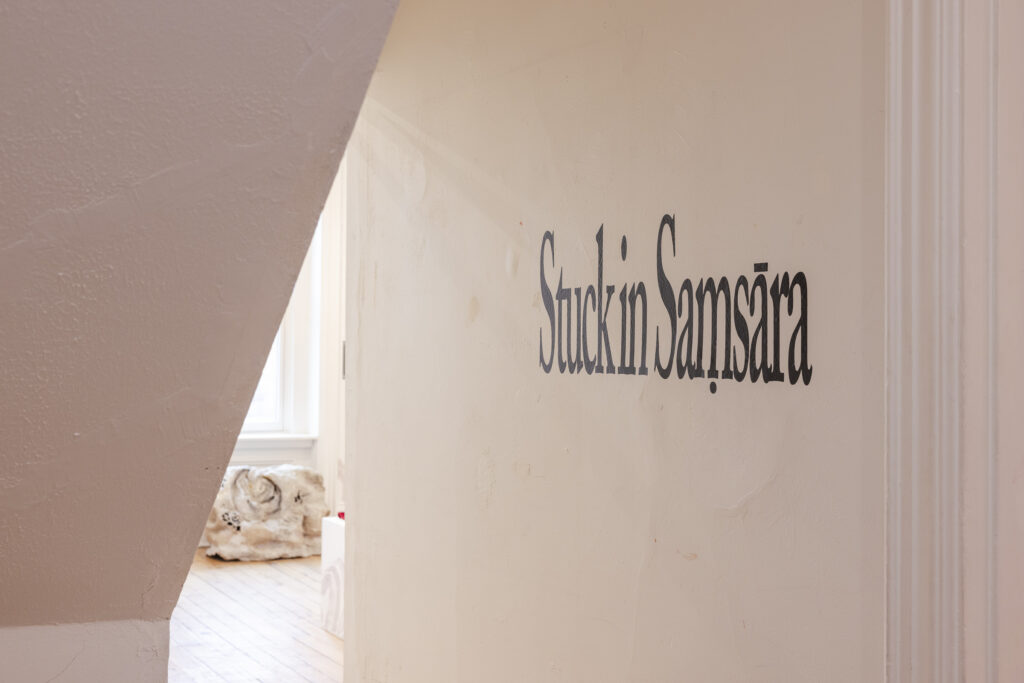
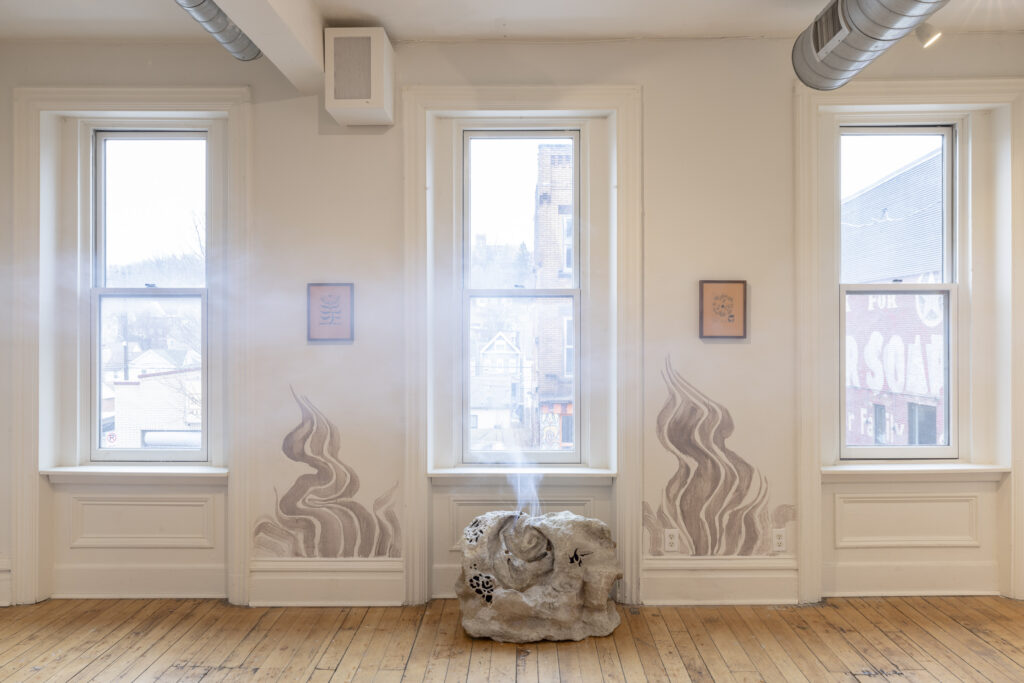
Brent Nakamoto, curator of Bunker Projects’ current exhibition, Stuck in Saṃsāra, says the root cause of (personal) suffering is that we want things to be different. When we are unable to accept our feelings or our situation, and what has caused us to get here, we fall into despair. When I talked to Brent about the show, I saw an immediate connection to the work that I make. As Brent says, artists are especially aware of suffering, both personally and on a larger scale, and the works in the show provide different lenses through which to think about suffering. So much of my practice is a process of working through my own suffering, grief, and hardships, by way of a physical embodiment of suffering and pain. Being diagnosed with a chronic illness has shaped how I move through the world, and it feels natural to use my art practice as a means of understanding my body. I place myself in precarious environments and poses in an attempt to regain autonomy over my body, which is often the source of my pain and suffering. However, with physical suffering comes psychological suffering, the torment of which feels the hardest to escape. Even when I feel like I have a grasp on treating my symptoms, flare-ups inevitably happen and the effects on my mental health are arguably the worst parts of this illness. Like a spiral, the thoughts wind in and around themselves, which is the rhythm suffering so often takes. As in the Lotus Sutra—the text that crystallizes Indian Buddhist philosophy—I am trapped in the burning house.
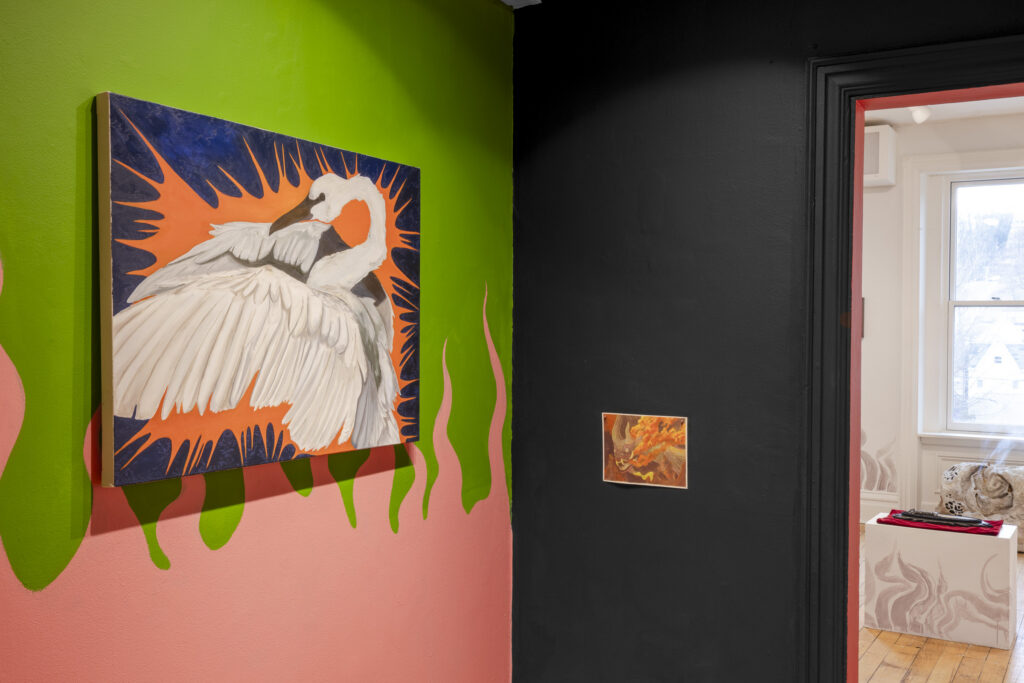
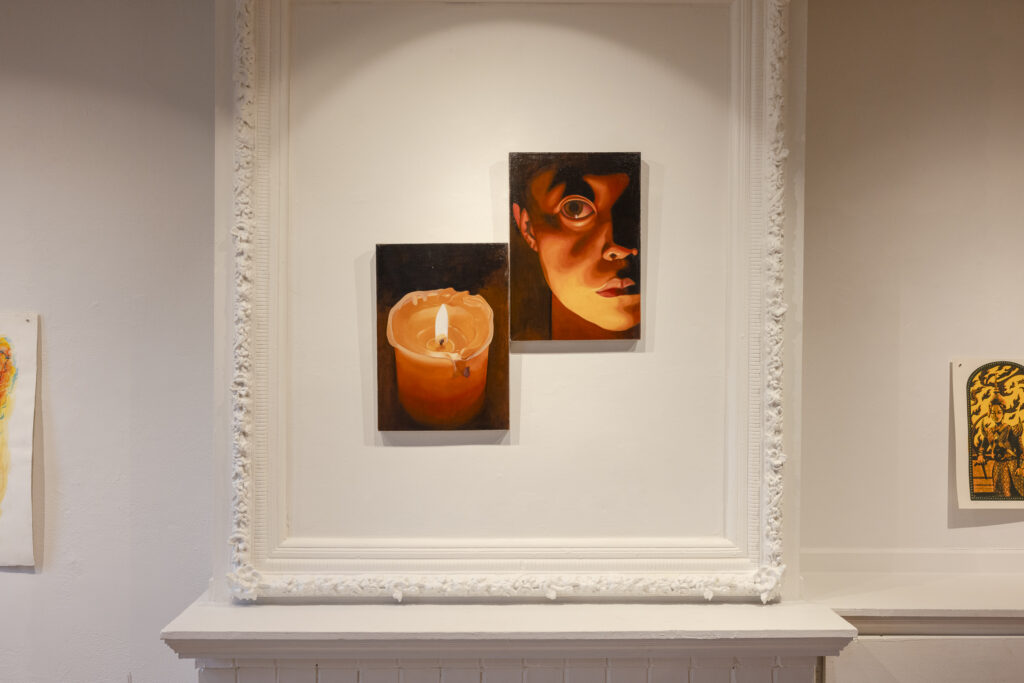
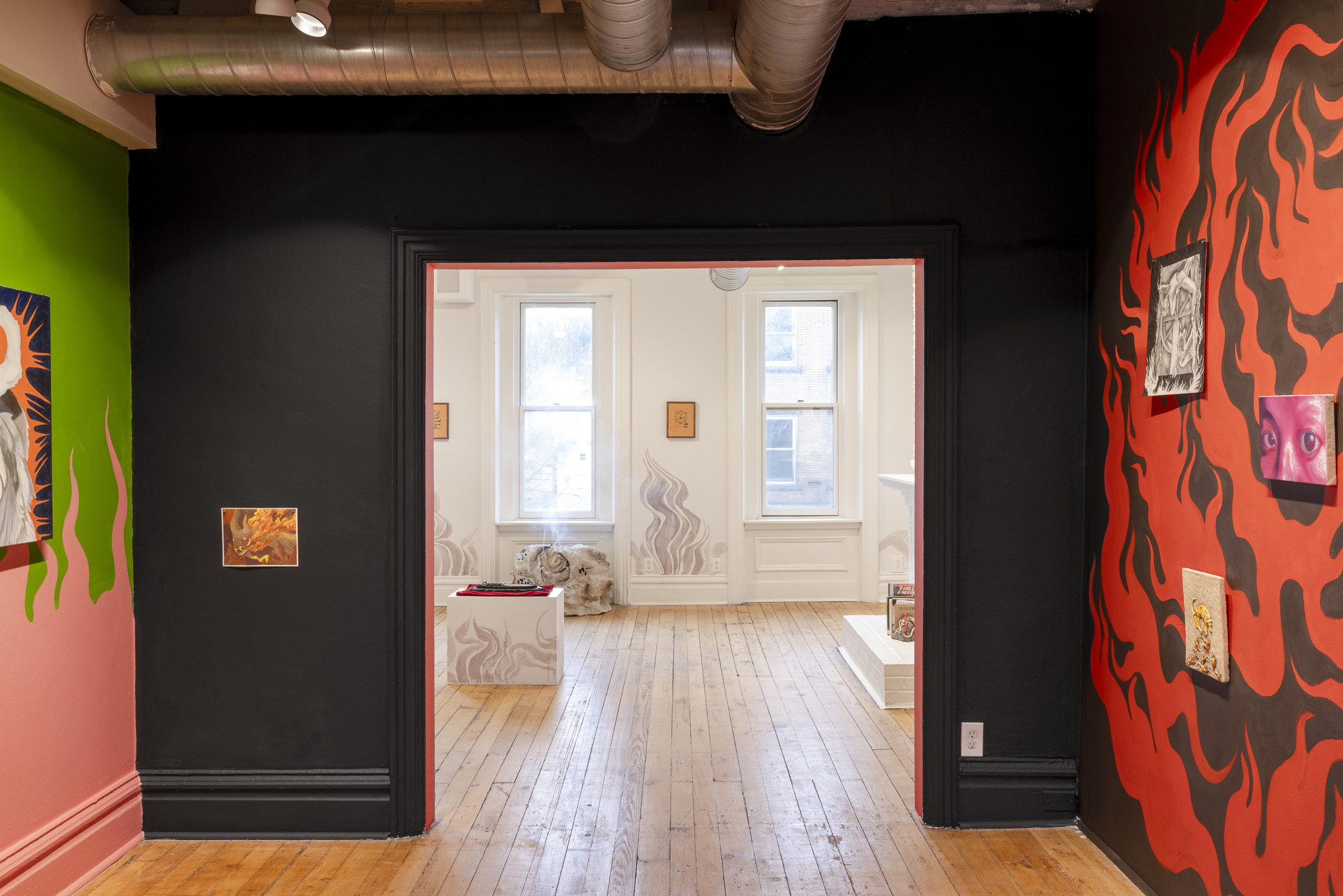
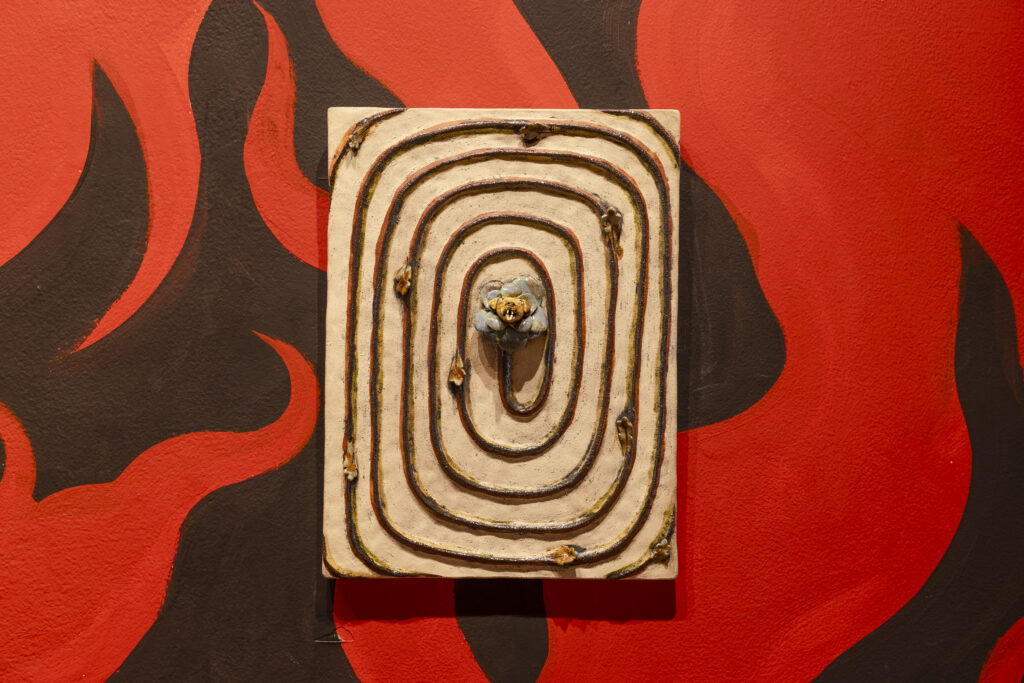
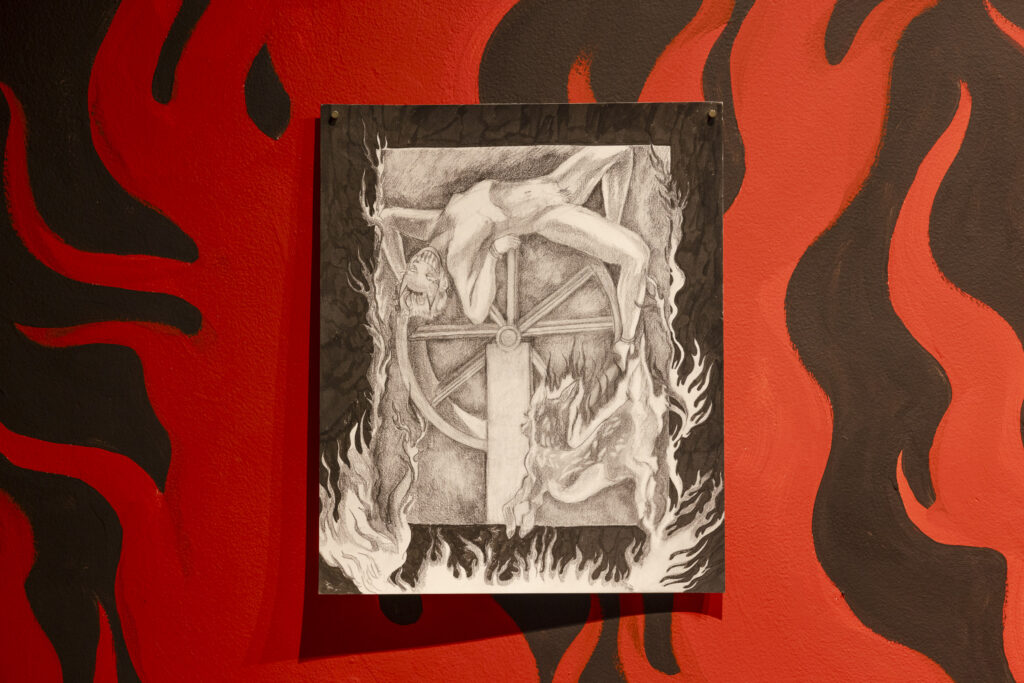
A spiral motif also appears repeatedly in the show, both literally and figuratively. In Martin Castro’s video piece Stuck in Saṃsāra, after which the show is named, we see the artist quite literally stuck in a spiral, getting punched in the face on repeat. As viewers, we are tiptoeing on the edge, anticipating the blow until it finally happens and the cycle starts over again. On one wall, a mural portraying spiral-like red flames engulfs the works installed on top. It pulls us into the blaze, into the internal world where these pieces live. We see the spiral again in Anthony Park Kascak’s Spiral, Bloom, in which his dog Bonzu is situated, mouth open, at the center. Our eye wants to follow the line around and around until we reach one end and reverse the direction. In Fortune’s Wheel Keeps Turning, Eriko Hattori depicts a figure tied to a wheel surrounded by flames while a fawn, already burning, bounds towards them. For me, this piece feels like a poignant interpretation of internal, personal suffering. There is no clear power imposing this suffering, no obvious thing that has tied the figure down. The figure wears a demon mask that smiles grotesquely, an image I interpret as either its complicity in the situation or a literal mask to hide their pain. The fawn, an innocent creature, easily startled, leaps forth without a clear path to escape the fire.
While I see the vast majority of the work in the show as a meditation on personal suffering, the show as a whole is a vehicle for thinking about systemic, political suffering. It’s no coincidence that all of the exhibiting artists identify as Asian American and Pacific Islander. I believe that those of us who possess marginalized identities, particularly with histories deeply rooted in migration (forced or otherwise), understand suffering in a different way. What I mean is that there is an empathy we contain and exhibit when we see suffering that is imposed on specific groups of people and eventually on everyone in general. We have a deep comprehension of atrocities that can and will be committed by governments that pretend to protect us or pretend to have our best interests in mind. Walking through the show, Brent and I discussed having to learn about this type of suffering as young children or adolescents because of our own experiences, and those of our parents, grandparents, and other ancestors. Genocide by colonial powers, internment camps, ICE raids, a systematic stripping away of basic rights—those in power have done this before directly to us or someone we love. There is a visceral cognizance of the suffering spiral: what we are witnessing in this current moment in time has happened before and will continue to happen. We know that history repeats itself, but how can we change the trajectory? What does it take to ensure that these sufferings have an end?
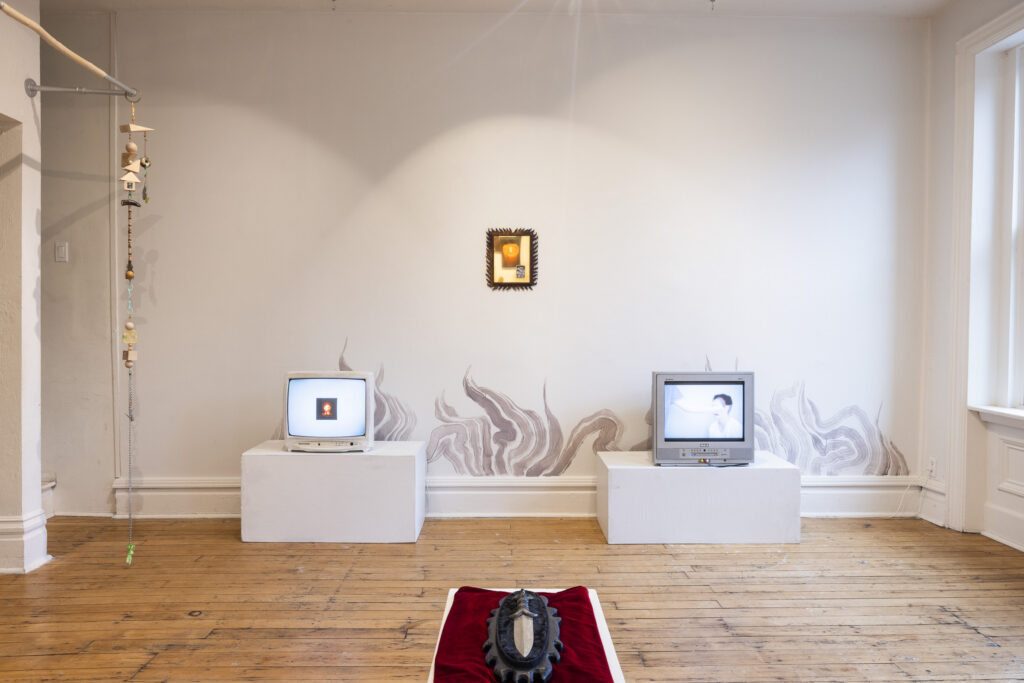
In Buddhism, anger is one of the three poisons, along with delusion (ignorance) and greed (lust, attachment). Buddhism teaches that these three poisons keep us trapped in saṃsāra and the opposite of these three—wisdom, generosity, and compassion—will lead us to liberation. On a parallel screen to Castro’s Stuck in Saṃsāra video, we see a swiftly rotating series of images depicting wildfires, volcanic eruptions, bombs dropped by Western powers. We see a glimpse of Aaron Bushnell self-immolating outside of the Israeli embassy in protest of Israel’s genocide in Palestine. This piece serves to bring us out of our internal world, situating us, and the show itself, in the present moment. I feel angry when I see it, angry at suffering’s persistence. I feel angry at our inability as humans to see beyond the center, beyond the individual. I feel angry that people still cannot see what is happening right in front of their eyes, or maybe choose not to believe it. And while being angry doesn’t feel good for me, it reminds me that my heart is in the right place. But now I am struggling to find a place to put this anger. Again, I wonder: What would it look like to exhibit my anger to the world?
Photography by Chris Uhren
Karen Lue is self-taught, image-based artist whose work explores aspects of identity and the physical body in relation to grief, ritual, and performance. Her most recent body of work uses analog photography as a starting point to examine how her identities as a queer, second-generation Chinese American woman function through a chronically ill body. Karen has exhibited at Silver Eye Center for Photography, Tomayko Foundation, Associated Artists of Pittsburgh, SPACE Gallery, and the Olin Fine Arts Center at Washington & Jefferson College, among others. She is the recipient of the Keystone Award Honorable Mention (2023) through Silver Eye Center for Photography and has received residencies through Cornell’s Image Text MFA program and Brew House Arts.
If you’d like to support Bunker Projects’ mission to provide a safe, equitable space for emerging artists to develop their practice and create new works for exhibition, please consider making a one-time or recurring donation here. We are so grateful for your generosity.