
Whenever Celeste Neuhaus and I have a conversation, it often turns at some point to the subject of magic. Celeste believes in the existence of supernatural phenomena, while I do not. STATE CHANGE, her recent show at Bunker Projects, nearly has me convinced that she’s right.
Celeste has a keen eye for finding places where the thin remnants of symbols and rituals that used to bind whole cultures together in shared practices and world views survive in watered-down and hollowed-out forms. She notices the plaited branches of a midwinter festival living on as a plastic wreath from the dollar store; the faint memory of nature goddesses inhabiting the pages of a fundraising calendar; a tantric mandala echoed in the form of a shooting-range target. Her show asserts that even in their attenuated state, these symbols can still act as containers strong enough to hold our compressed rage, can still wrap us in a threadbare solace, can still be re-imagined and re-purposed into communal actions that connect and heal.
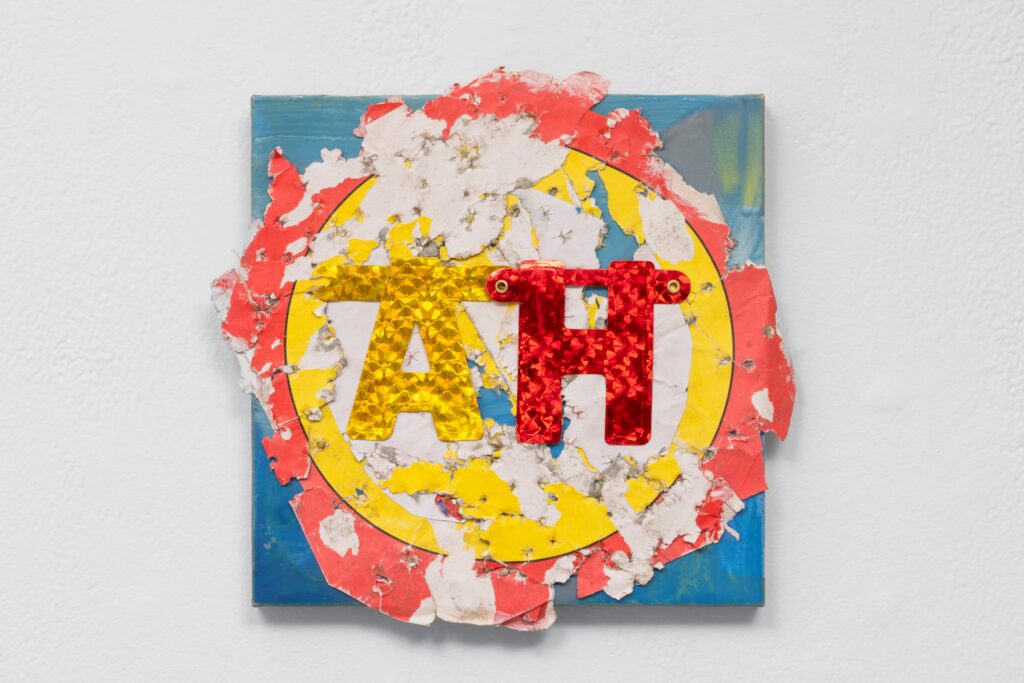
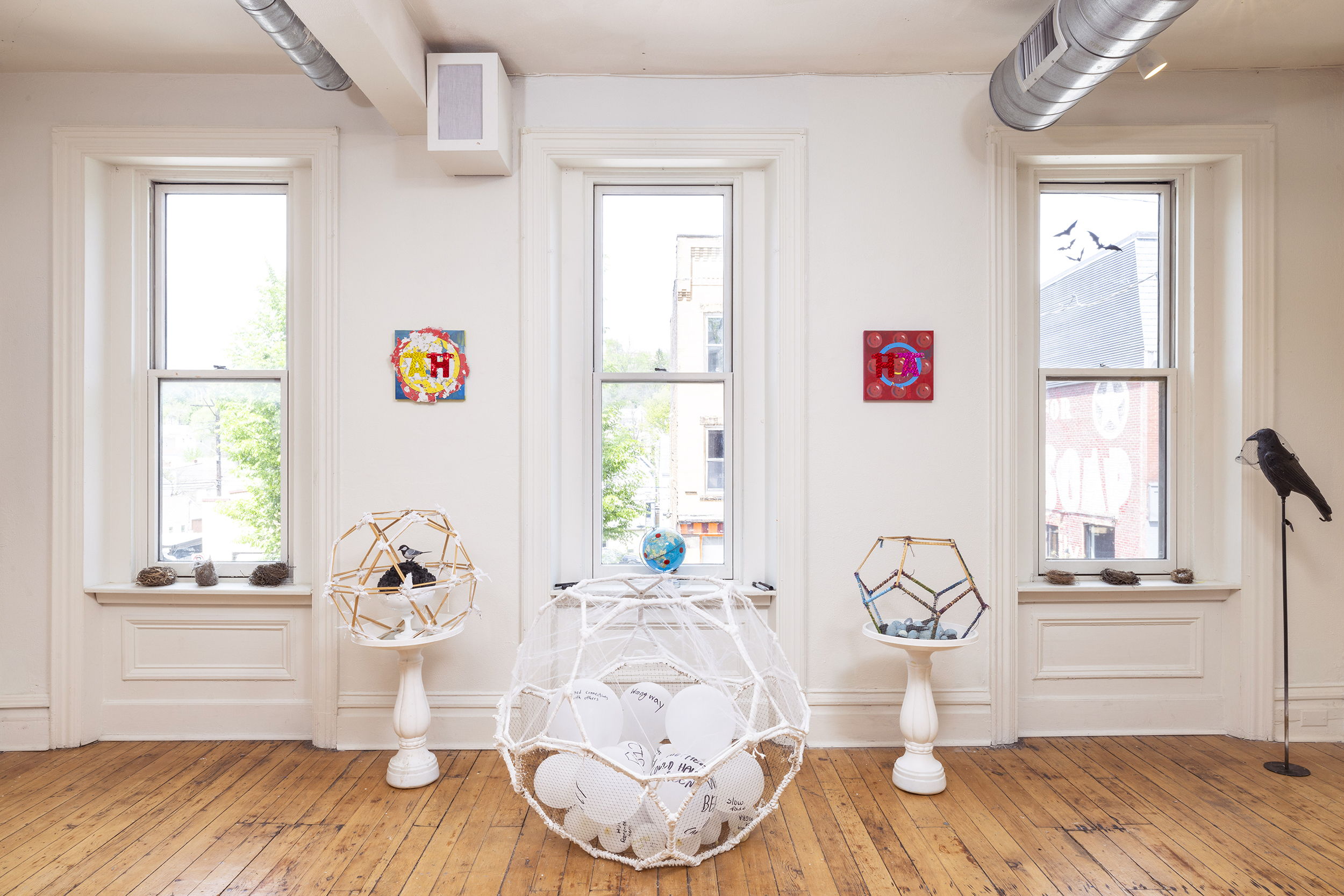
The work abounds in painful ironies, but they are delivered with a light touch. In the double collage/painting titled Awakening, shredded targets and clown noses from a party game support the words “Ah” and “Ha,” both apparently cropped from a birthday garland, forwards and backwards creating a palindromic loop of meaning and inducing in me a half-unconscious loop of breathing—ah-ha-ah-ha-ah—on and on towards what? Hilarity? Enlightenment? Activation of the parasympathetic nervous system? It feels like some combination of all three.
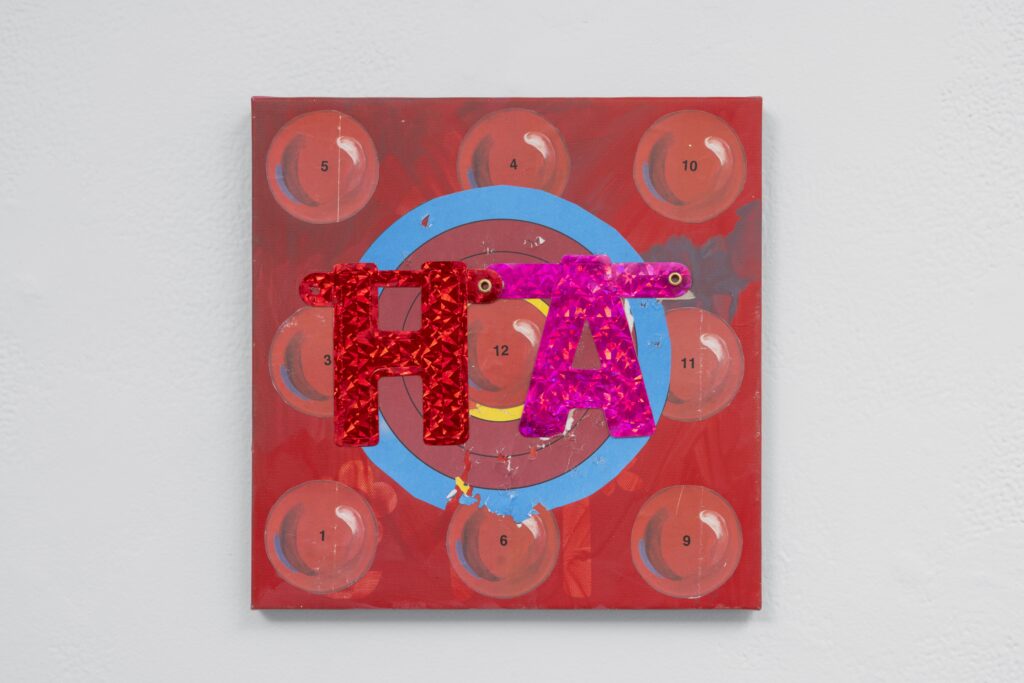
Awakening used archery and shooting targets, birthday garland, paint, pin the nose on the clown birthday game
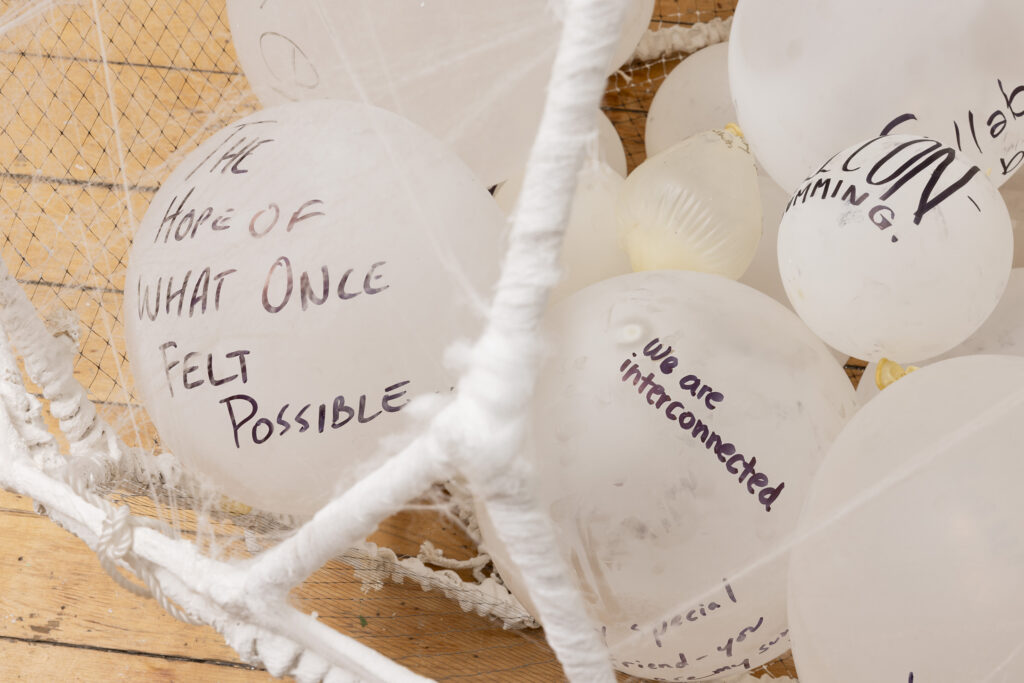
Directly between these two panels, the languages of doom and hope from environmentalist fundraising brochures are used as material to build a structure to contain other breaths, specifically the breath of gallery visitors who filled balloons while meditating on grief—breath infused with loss and despair. Are those feelings actually, literally, somehow held within these membranes of latex? Does it matter whether or not they are, as long as I can feel the vulnerability and sadness in the air as the balloons slowly shrink, releasing their secondhand breath into the gallery? And what kind of birthday party is this, anyway?
For those inclined more towards rage than grief, Celeste provides a ritual of fire and a sculpture titled Scorched Hearth that uses the existing fireplace of the gallery as pedestal, creating a palimpsest of clean white domesticated hearth behind an earthier, oxidized, elemental, cast-iron hearth materially elaborated with wood, rope, roots, and scorched paper. Language and multiple meanings are everywhere important to this work; Asbestos-brand sad irons double as funerary boats, the maw of the iron stove, echoed by the open mouths of the diminutive plaster lion, wolf, and bear above, is emblazoned with the brand name “Favorite” and festooned with vintage neckties. A plastic snake slithers across the mantel and plastic flower pistils fill the sad iron boats. Symbols and evocations of gender and power are tangled and remixed.
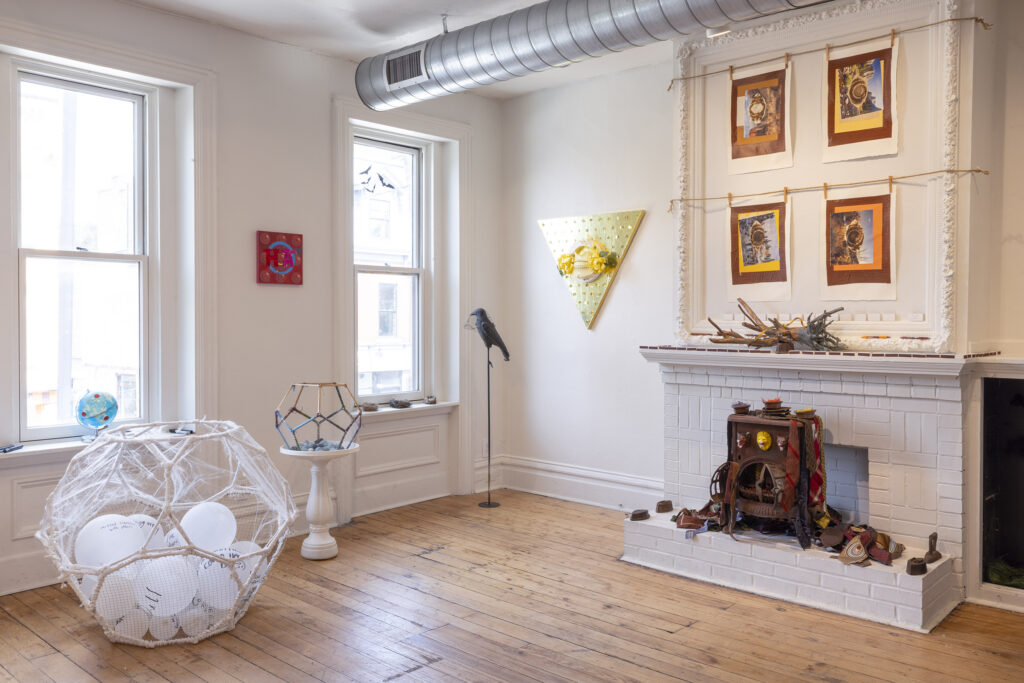
Scorched Hearth: iron stove, sad irons, ties, wooden clothes pins, match boxes, plastic flower pistils, vacuum form cast Asbestos-brand sad irons, Boy Scouts craft lion, wolf, and bear, natural rope, iron oxide painted tree roots, wood print contact paper, burner scorched stationary, environmental conservation organization fundraising calendars.
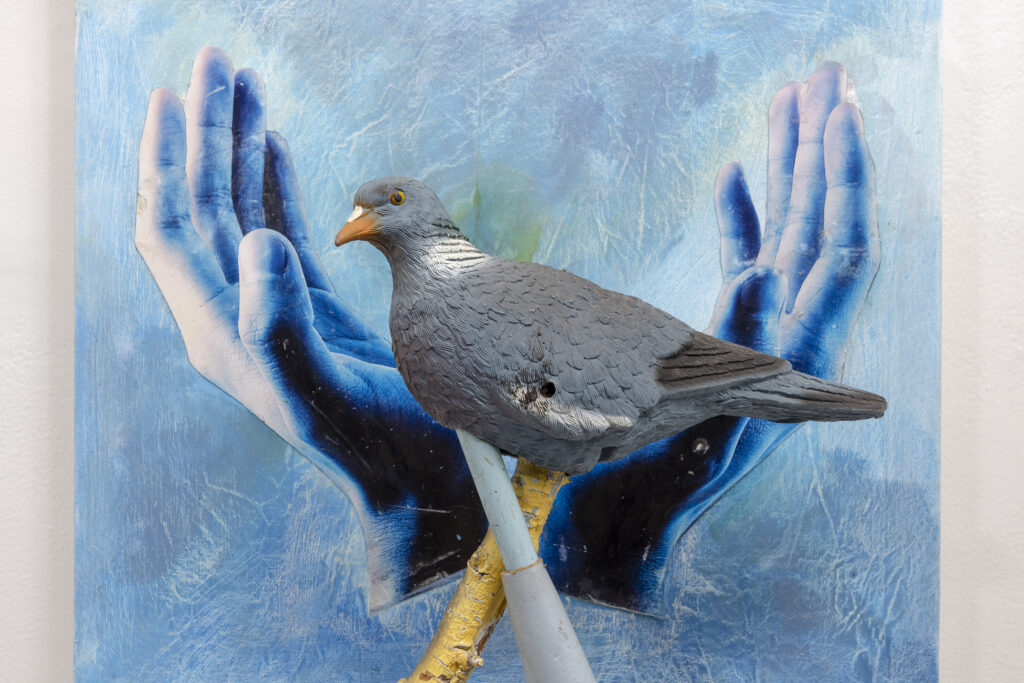
Directly across the room, another snake, wrapped in plaster gauze, rises from atop a stack of car tires that has been festooned with a patriotic skirt of flags and neckties. This discomfiting object brings to mind hypermasculine performativity at the same time that it deflates those pretensions. The ties are ridiculous; the snake is broken and bandaged in a full body cast, transforming a gesture of threat and aggression into an image of care and compassion. The paintings on the wall continue the conversation of dualities fusing into unities, of layers telescoping within layers, and of elemental meaning to be found everywhere one looks.
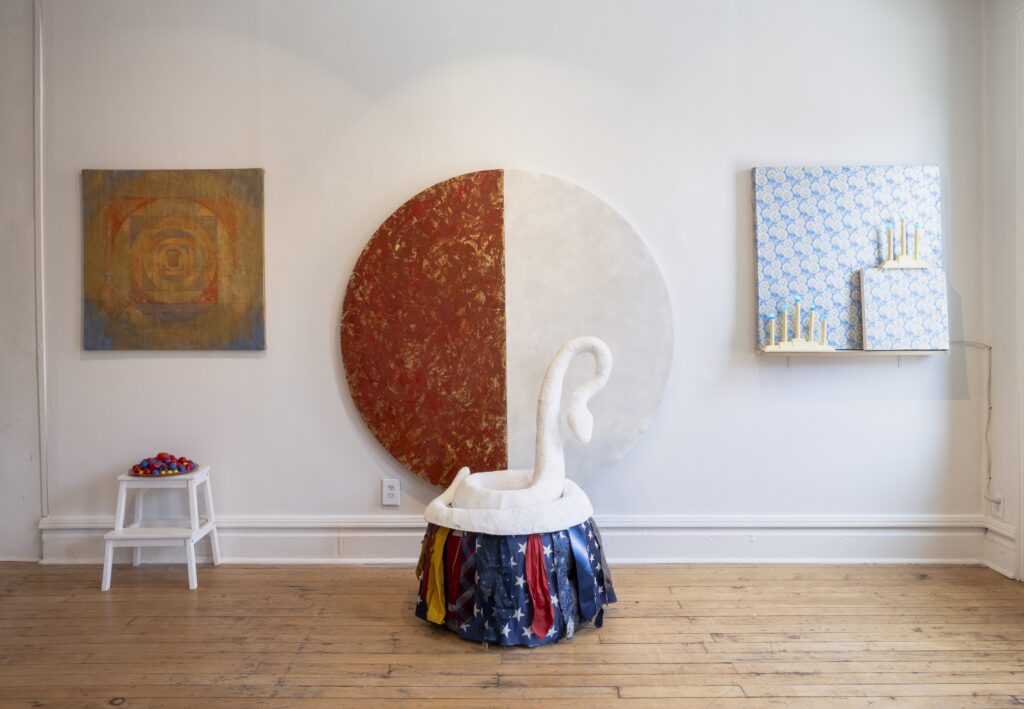
Fruitful Union: gold leaf, rain, iron oxide, glass beads, paint, tires, flag fragments, ties, plaster bandages
In fact, everywhere one looks in this show, from the overture of collages in the hallway to the diorama in the bookcase, transubstantiations are taking place. Everything is in the process of turning into something else. This alchemical process of mixing elements, metamorphosing their forms, transmogrifying their substances, and transforming their meanings, is the art—or the magic—at the generative heart of Celeste’s work.
Photography by Chris Uhren
Clayton Merrell grew up in Pittsburgh, PA, and Puerto Ordaz, Venezuela. He studied painting and printmaking at the Yale School of Art, where he earned an MFA in 1995. He was awarded a Fulbright Grant for research and creative work in Oaxaca, Mexico in 1996-97. His work is exhibited widely, with recent exhibitions at: Slow Gallery, Chicago; the Smithsonian National Air and Space Museum, Washington DC; Concept Gallery, Pittsburgh PA; the A+D Gallery, Chicago; the Westmoreland Museum of Art, and the Chautauqua Institution, Chautauqua NY. His work is in the collections of the American Embassy in Belmopan, Belize, the Smithsonian Museum, the Anderson Museum of Contemporary Art, the U.S. Department of the Interior, and numerous private and corporate collections. He was the 2005 Artist of the Year at The Pittsburgh Center for the Arts, and in 2016 was named Creator-of-the Year by the Pittsburgh Technology Council. He has received awards and grants from the Virginia Center for the Creative Arts, Skowhegan, The Millay Colony for the Arts, the Blue Mountain Center, the Vermont Studio Center, ProArts, Artists Image Resource, and the Center for the Arts in Society. During 2004-05 he was a fellow at the Roswell Artist-In-Residence Foundation in Roswell, New Mexico. In 2015, Pittsburgh International Airport completed construction of a 69,000 square foot terrazzo floor image based on his design. He is currently the Dorothy L. Stubnitz Professor of Art at Carnegie Mellon University.